Escape - Application Security & Offensive Security Blog
Explore practical offensive and application security insights covering web application testing, emerging AI cybersecurity research, API and GraphQL security, and advanced testing techniques.

Filters
Escape joins the GraphQL Foundation to push for a more secure ecosystem
Alongside AWS, Microsoft, META, and PayPal, Escape has joined GraphQL Foundation to lend a hand to the GraphQL community in securing their APIs.
Two years have passed since Escape members dedicated their work to providing all the necessary tools, support, and information to help the GraphQL community develop the most

1 min read
Introducing PyMultiAuth - The ultimate Python Authentication Toolkit
Nowadays, whenever you enter a web application, chances are that it uses some API (REST or GraphQL). Why? Simply because APIs are very beneficial and cost-effective, but despite the numerous advantages that APIs bring to the table, there is one disadvantage that to me as a cyber security engineer outweighs
Pentesting GraphQL 101 Part 3 - Exploitation
This article is part of the series "Pentesting GraphQL 101".
1. Pentesting GraphQL 101 Part 1 - Discovery
2. Pentesting GraphQL 101 Part 2 - Interaction
3. Pentesting GraphQL 101 Part 3 - Exploitation
Exploitation or finding vulnerabilities might not be the most crucial step in a typical
6 min read
Find your way in GraphQL applications - Paths explained
One GraphQL benefit over REST is that you can define a generic backend to serve applications.
GraphQL defines its data schema, explicitly providing which object lives in the current application and operations to query these objects.
Introduction
Let's start with an example schema.
type User {
name: String!
organization:

3 min read
Announcing GraphQL Armor support for GraphQL Yoga 2 - Bringing security by default to GraphQL
We are utterly excited to introduce GraphQL Armor compatibility with Yoga 2.
When the GraphQL Ecosystem encounters Security
A few weeks ago, we released GraphQL Armor, an open-source middleware to add a security layer on top of GraphQL endpoints and mitigate common attacks.
GraphQL Armor blocks abusive requests by putting

2 min read
Forging GraphQL Bombs, the 2022 version of Zip Bombs
Zip Bombs are a thing of the past, but the concept behind them is still relevant nowadays. Indeed, your GraphQL application might be vulnerable to what we'll call GraphQL Bombs in this article. Read on to know if you're vulnerable and how to secure your GraphQL

5 min read
Using Rate Limiting to protect your GraphQL API against Brute Force Attacks
For several days now, your users have been complaining about losing access to your web service. If at first you thought it was a simple coincidence and certainly a fault of the users, the incident starts to be strongly repeated and noticed.
You rush to your monitors and notice an

5 min read
Introducing GraphQL Armor - Make GraphQL more Secure than REST in minutes
We released GraphQL Armor, a middleware for Apollo Server that adds a security layer to any GraphQL endpoint in minutes.
☠️ GraphQL less secure than REST, really?
While being so much more convenient to use, GraphQL is known to introduce security vulnerabilities compared to most modern REST implementations.
But GraphQL is

2 min read
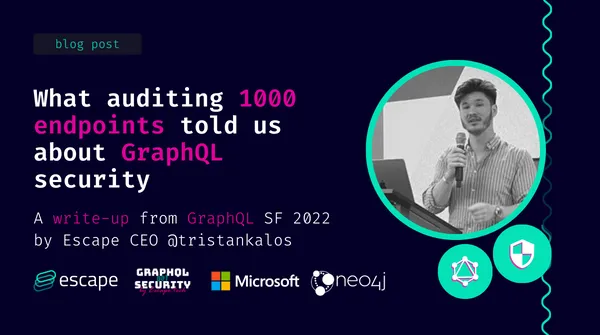
What auditing 1000 endpoints told us about GraphQL Security Best Practices
This post is a write-up of a talk I gave at the GraphQL San Francisco Conference. You can find the video on youtube. If you are in the bay area do not forget to also join the GraphQL SF group on meetup.
It's commonly said that GraphQL is

9 min read
Pentesting
GraphQL Pentesting 101: Part 2-Interaction Explained
A Pentester is usually expected to be a higher than average user in terms of interaction with an endpoint. For that reason, I decided to add an intermediary step between "Discovery" and "Exploiting" called "Interaction."
This article is part of the series "Pentesting
5 min read
Postman
How to Use GraphQL with Postman: A Complete Guide
If you're building an API, you need tools to query it. Postman is the go-to tool for querying APIs, whether using the Postman GraphQL client or the Postman HTTP request interface. It allows you to create and send requests to your endpoints and so much more.
Postman has

5 min read
Pentesting
GraphQL Discovery: Pentesting GraphQL 101 Part 1
Recent statistics say that you have queried at least one GraphQL endpoint today. For me, as a Penetration tester, it is just a matter of concern, especially since high-quality Pentesting guides/articles are scarce online, which only signals that GraphQL security is still rudimentary.
So I decided to start this
6 min read

Announcement
GraphQL Postman Collection: Generate Instantly with GraphMan
While querying, developing, and testing your GraphQL APIs with postman is easy and convenient, it has a big caveat: if you want to cover an endpoint with all its queries and mutations entirely, it will take you hours and repetitive steps to create every request, and you'll almost
3 min read
GraphQL Vulnerability
GraphQL Cyclic Queries and Depth Limiting
The relational aspect of GraphQL can be a vulnerability exploited by running deep and cyclic queries causing your API to crawl under the load and crash. That's a Denial of Service. Learn how it works and how you can protect your API!
6 min read
GraphQL Vulnerability
SQL Injection in GraphQL
You receive a call in the middle of the night from the SRE team:
All production data has been deleted from your company's various relational databases.
Many of the company's internal services are therefore down. You absolutely need to fix the problem immediately and identify the
5 min read
GraphQL Vulnerability
File Inclusion and Directory Traversal in GraphQL
Back at the office, you try to connect to one of your application's servers. But for some reason, your account is no longer granted access.
Anyway. You have a backup so you can restore it to a previous state in a minute. Still, you have to figure out
5 min read
GraphQL Vulnerability
How to prevent data leaks with HTTPS
HTTP is the text protocol that has been running the web, but its upgraded version HTTPS should always be preferred to avoid data leaks. Read more to understand the risk and how you can implement the security fix in your GraphQL framework of choice.
5 min read
GraphQL Vulnerability
Understanding and Dealing with Cross-Site Request Forgery Attacks (CSRF) in GraphQL
CSRF (Cross-Site Request Forgery) is one of the top 3 most common vulnerabilities of web applications. It forces authenticated users to perform unwanted actions. In this post, we explain how it works and how to remediate it in your GraphQL API.
5 min read
Don’t let your vulnerabilities escape.
Ready to multiply your force, not just noise?
Book a demo
Book a demo