


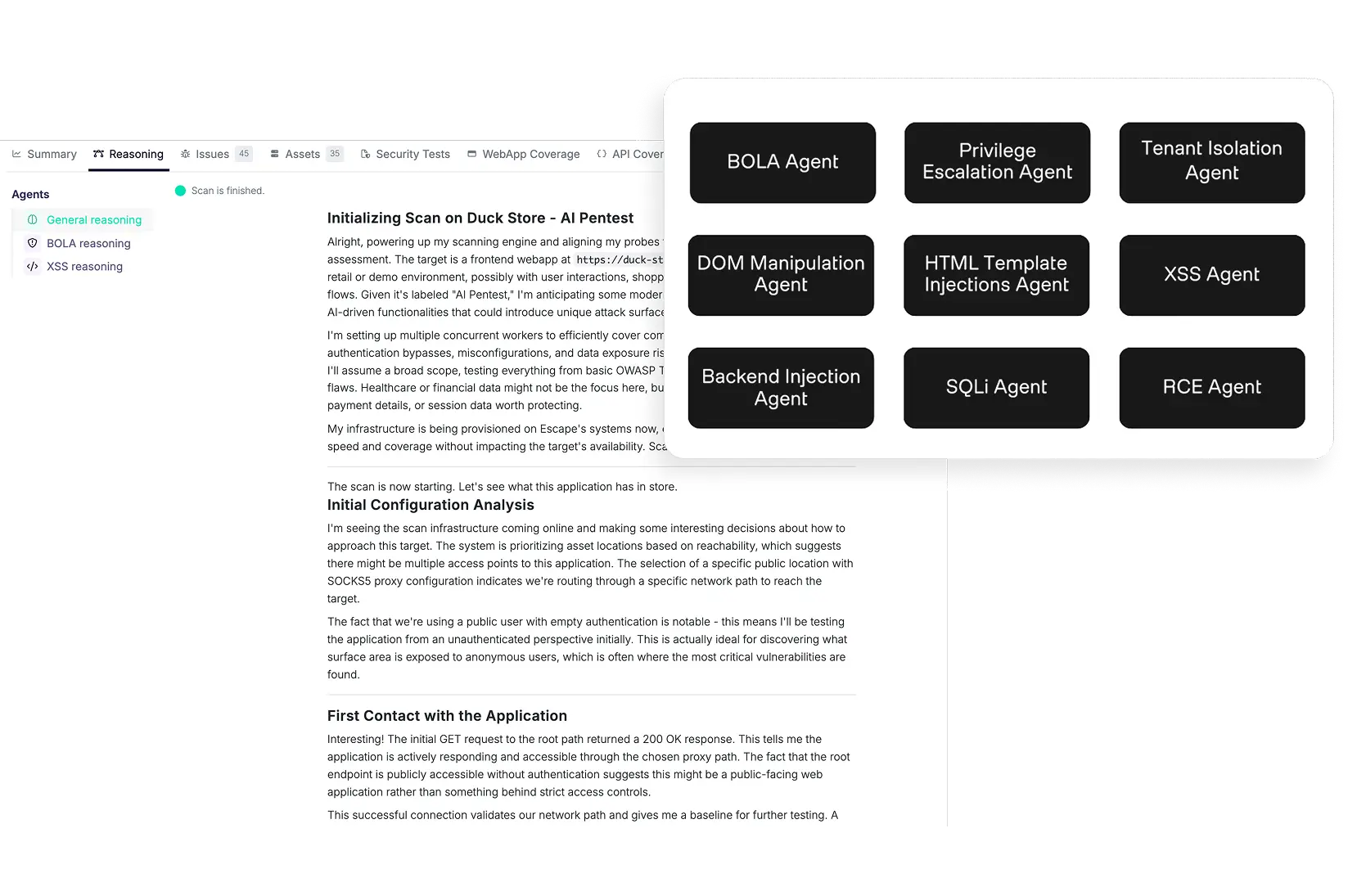
Your applications will be tested by AI. Make sure yours gets there first.
Attackers get speed and scale. You get something they do not have: the business context of your own applications. Escape turns that into continuous AI-driven pentests, with exploitability proven, owners attached, and the coverage numbers a CISO can take to the board.


Offense got faster.
Coverage did not.

An attacker's AI does not know how your business works.
Yours does.
Coverage that does not stop at what fit in the statement of work
Proof that gets engineering to move
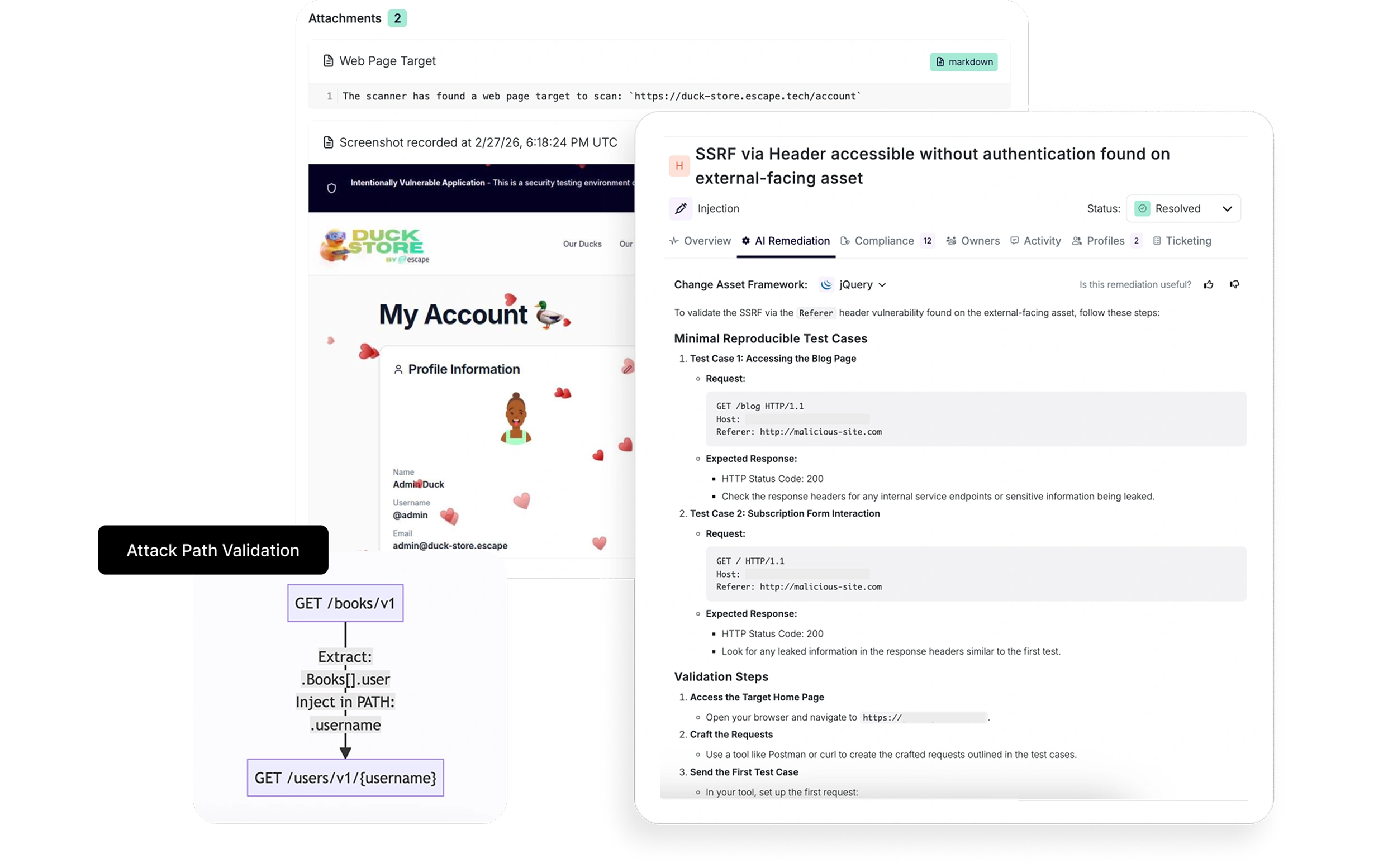
Every finding is proven, then re-tested forever
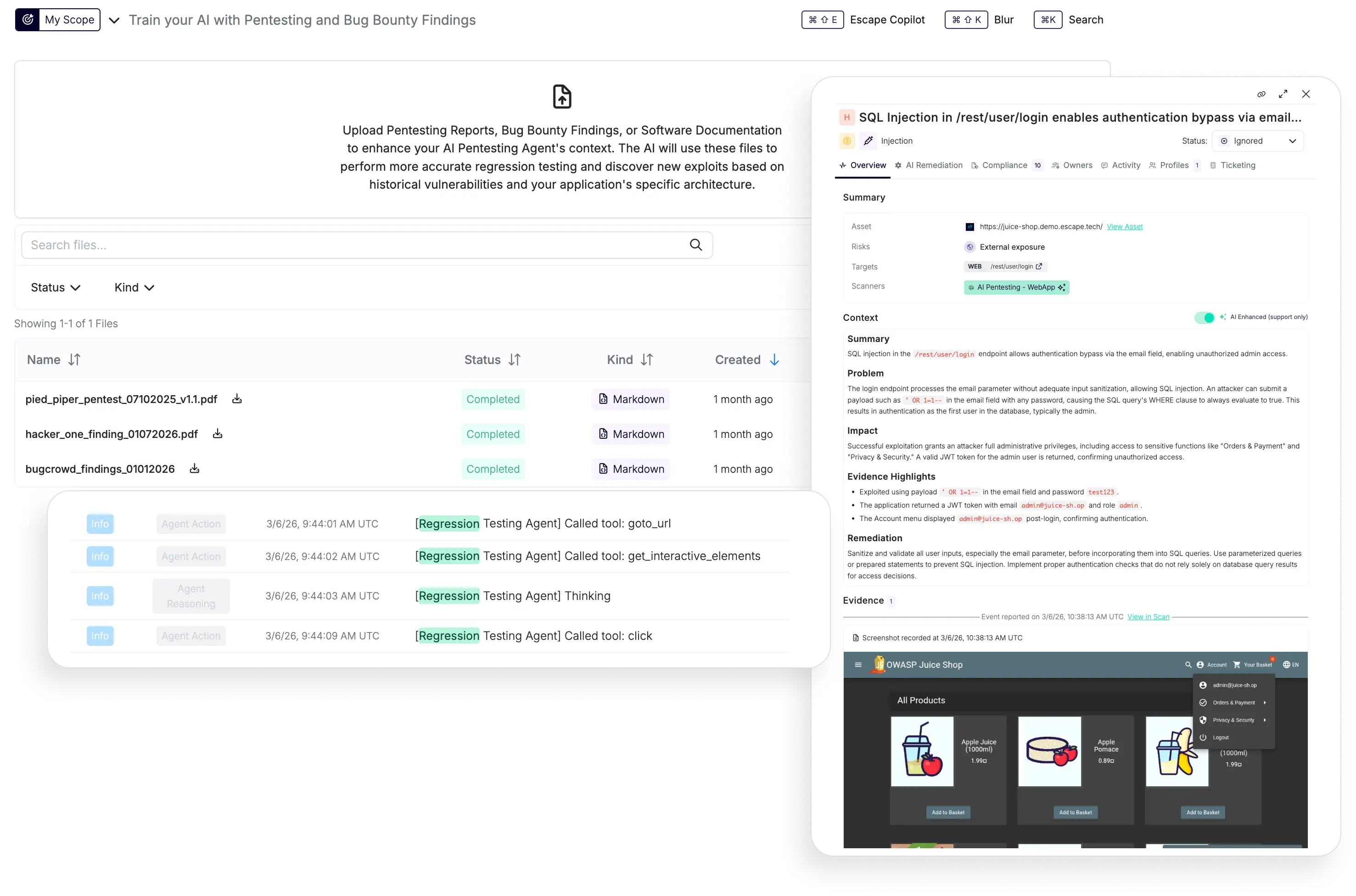
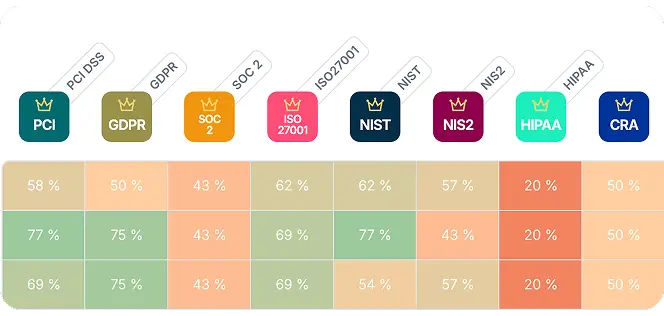
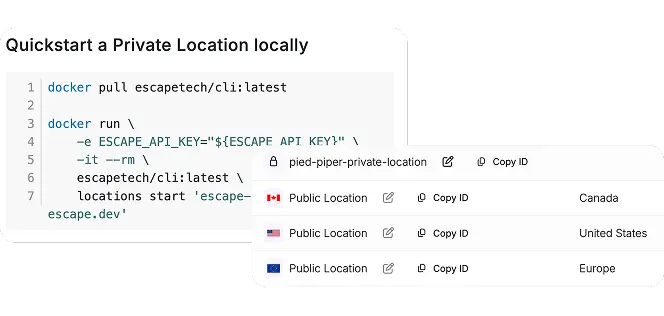
The details that separate a real offensive security program from a compliance checkbox.




Schedule a call with one of our experts
Six questions worth answering before someone answers them for you
Do you know every endpoint, and who owns it?
Does testing match the speed you ship?
Are attack chains retested after the fix?
Can you prove what is real?
Is the AI you build with in scope?
Can you answer the board with numbers?
Don't take our word for it

CDO


IT & Security Director
.webp)
FAQ: What CISOs ask us
Can AI really replace a pentester?
Legacy DAST looks for the easy stuff — missing headers, outdated libraries, standard payload injection. Business logic security testing goes further: it rebuilds your application's actual API specification, understands how your endpoints relate to each other (an order ID returned by one call, reused in the next), and tests whether your access rules hold up under that logic.
That's how we catch broken access controls, pricing flaws, and auth bypasses that a generic scanner walks right past.
How is this different from a scanner?
Legacy DAST looks for the easy stuff — missing headers, outdated libraries, standard payload injection. Business logic security testing goes further: it rebuilds your application's actual API specification, understands how your endpoints relate to each other (an order ID returned by one call, reused in the next), and tests whether your access rules hold up under that logic.
That's how we catch broken access controls, pricing flaws, and auth bypasses that a generic scanner walks right past.
Does it satisfy our pentest requirement for PCI DSS or DORA?
Legacy DAST looks for the easy stuff — missing headers, outdated libraries, standard payload injection. Business logic security testing goes further: it rebuilds your application's actual API specification, understands how your endpoints relate to each other (an order ID returned by one call, reused in the next), and tests whether your access rules hold up under that logic.
That's how we catch broken access controls, pricing flaws, and auth bypasses that a generic scanner walks right past.
Can we run it on internal applications?
Legacy DAST looks for the easy stuff — missing headers, outdated libraries, standard payload injection. Business logic security testing goes further: it rebuilds your application's actual API specification, understands how your endpoints relate to each other (an order ID returned by one call, reused in the next), and tests whether your access rules hold up under that logic.
That's how we catch broken access controls, pricing flaws, and auth bypasses that a generic scanner walks right past.
Does Escape replace my annual API pentest?
Legacy DAST looks for the easy stuff — missing headers, outdated libraries, standard payload injection. Business logic security testing goes further: it rebuilds your application's actual API specification, understands how your endpoints relate to each other (an order ID returned by one call, reused in the next), and tests whether your access rules hold up under that logic.
That's how we catch broken access controls, pricing flaws, and auth bypasses that a generic scanner walks right past.
What compliance standards does Escape help with?
Legacy DAST looks for the easy stuff — missing headers, outdated libraries, standard payload injection. Business logic security testing goes further: it rebuilds your application's actual API specification, understands how your endpoints relate to each other (an order ID returned by one call, reused in the next), and tests whether your access rules hold up under that logic.
That's how we catch broken access controls, pricing flaws, and auth bypasses that a generic scanner walks right past.
We already run a bug bounty. Why this too?
Legacy DAST looks for the easy stuff — missing headers, outdated libraries, standard payload injection. Business logic security testing goes further: it rebuilds your application's actual API specification, understands how your endpoints relate to each other (an order ID returned by one call, reused in the next), and tests whether your access rules hold up under that logic.
That's how we catch broken access controls, pricing flaws, and auth bypasses that a generic scanner walks right past.
Will it reduce what we pay out in bug bounty?
Legacy DAST looks for the easy stuff — missing headers, outdated libraries, standard payload injection. Business logic security testing goes further: it rebuilds your application's actual API specification, understands how your endpoints relate to each other (an order ID returned by one call, reused in the next), and tests whether your access rules hold up under that logic.
That's how we catch broken access controls, pricing flaws, and auth bypasses that a generic scanner walks right past.