

Escape Research
Next-Generation AI for Cybersecurity Research
Escape rebuilds offensive and application security from the ground up: business logic testing, agentic pentesting, code-to-cloud correlation. Everything you see in the product started here. Always developed in-house.
5
3–4×
267, 101
2,000+
Our mission
Security teams are drowning in noise and siloed tools that are absurdly complicated to operationalize or simply outdated. The relationship with engineering is a permanent negotiation. Balancing risk reduction against shipping velocity is a trade-off most orgs are still forced to make. We don't think they should have to.
We think the current AI wave changes the unit economics of offensive security. Pentesting was always a bottleneck because it was human-time-bound. It isn't anymore. So we're rebuilding the tools, the processes, and the practices and publishing what we find, including the parts that don't work.
Our goal is to create Artificial Intelligence that empowers security and engineering teams to work together and create secure software faster.
See our latest benchmarkWe think the current AI wave changes the unit economics of offensive security. Pentesting was always a bottleneck because it was human-time-bound. It isn't anymore. So we're rebuilding the tools, the processes, and the practices and publishing what we find, including the parts that don't work.
Our goal is to create Artificial Intelligence that empowers security and engineering teams to work together and create secure software faster.

Research topics
/01
Code-to-Cloud Security Intelligence
From AST to runtime behavior
Our research explores the link between static code structure and runtime behavior across distributed microservices. By analyzing Abstract Syntax Trees, our models generate precise security tests that uncover business logic vulnerabilities from development to deployment.
/02
Agentic Offensive Security
Reinforcement learning on live targets
Building on research like Microsoft’s REST-ler, we use reinforcement learning to enable autonomous security testing. AI agents learn application behavior through interaction and uncover complex attack paths that traditional scanners often miss.
/03
AI-Powered Vulnerability Remediation
exploitable finding → source-code fix
We’re exploring how large language models can connect runtime vulnerabilities to their source code origins. This helps developers fix issues faster by turning security findings into actionable code changes.
/04
Vision AI Authentication
Login flows without login scripts
Our research uses computer vision to automate authentication for dynamic security testing. By navigating login interfaces without manual scripting, it removes a major barrier to continuous testing.
/05
Intelligent Asset Correlation
Repo to deployed API, automatically
We’re researching how to automatically map relationships between source code repositories and deployed APIs. This creates clearer visibility across the deployment pipeline and improves vulnerability traceability.
Whitepapers and Articles
Filters
Thank you! Your submission has been received!
Oops! Something went wrong while submitting the form.
Benchmarks
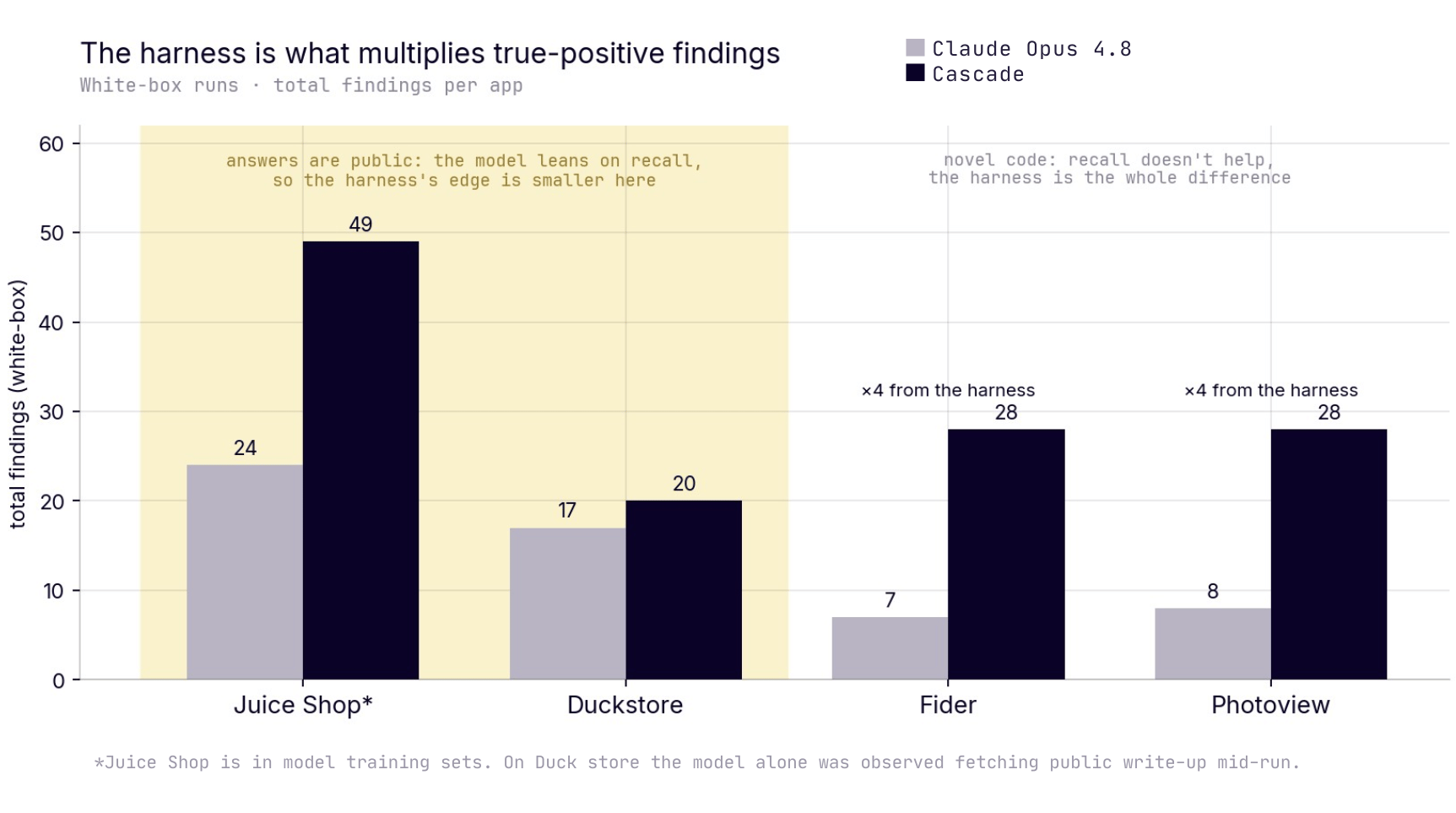
Modern AI-powered Pentesting Tools In-Depth benchmark
Cascade, Escape’s multi-agent AI pentesting engine, went up against a single frontier model (Claude Opus 4.8) driven directly at the same targets. The only variable is the harness around them.
AI Pentesting
Agentic Offensive Security
Benchmarks
.png)




.png)
Don’t let your vulnerabilities escape.
Ready to multiply your force, not just noise?
Book a demo
Book a demo