Escape vs Pentera: how each one proves exploitability (2026)

Most teams arrive at this comparison with the wrong framing: two automated penetration testing platforms, pick one.
Start with what Pentera actually is, because the comparisons that skip this get everything after it wrong. Pentera is an exposure validation platform with a key focus on network testing, and a good one. Pentera Core runs inside your network doing what a red team does in the first week of an engagement: cracking credentials, moving laterally, escalating privilege, testing Active Directory password strength, emulating ransomware to see how far it spreads before anything stops it. Agentless, safe against production, on a schedule you set.
Pentera Surface points the same engine outward at everything reachable from the internet. VPNs, SSH, Git, storage, exposed services, leaked credentials tested to confirm whether they still work. Web applications too, with OWASP Top 10 testing and payloads adapted to whatever authentication it runs into.
Escape is a genuine Pentera alternative, and also runs external network pentesting, and that is where the two genuinely overlap. Continuous asset discovery from cloud accounts, DNS and raw IP ranges, around 4,000 TCP ports per host, a CVE corpus rebuilt daily, and default credentials confirmed by a login that actually succeeded rather than a version that merely matched. Every exposed asset carries the context that settles it: where it was found, which region and business unit owns it, what environment it lives in, whether it should be public at all. Criticality is scored on real exposure; for multi-brand orgs, findings route themselves to the right team, brand, or subsidiary.
The key difference, though, is that for Escape, the perimeter is where testing starts, not where it lands. Behind every exposed service, Cascade, Escape's AI pentesting engine, runs against the applications themselves. It builds a working model of how each web app and API behaves across roles, sessions and states, then attacks that model, reasoning about where the logic gives rather than firing a payload list at it. That runs on every change and every build, not as a scheduled campaign, so an authorization boundary that a dev loosened on Tuesday gets tested on Tuesday.
So the easy version of this comparison, just between "AI-driven pentesting tools", is wrong, as a network tool versus an application tool. Both test the perimeter. They diverge on what happens after it.
Here is the distinction between the two tools in-depth.
The short version
Pentera proves how an attacker gets in. Pentera Core validates internal network paths through credential attacks, lateral movement and privilege escalation. Pentera Surface tests everything reachable from the internet, including web applications, using OWASP Top 10 targeted testing and payloads adapted to the authentication model it finds. Pentera Cloud covers cloud identity and hybrid attack paths. The through-line is initial access and attacker progression.
Escape proves what is actually exploitable in the applications and APIs, at both ends of the session.
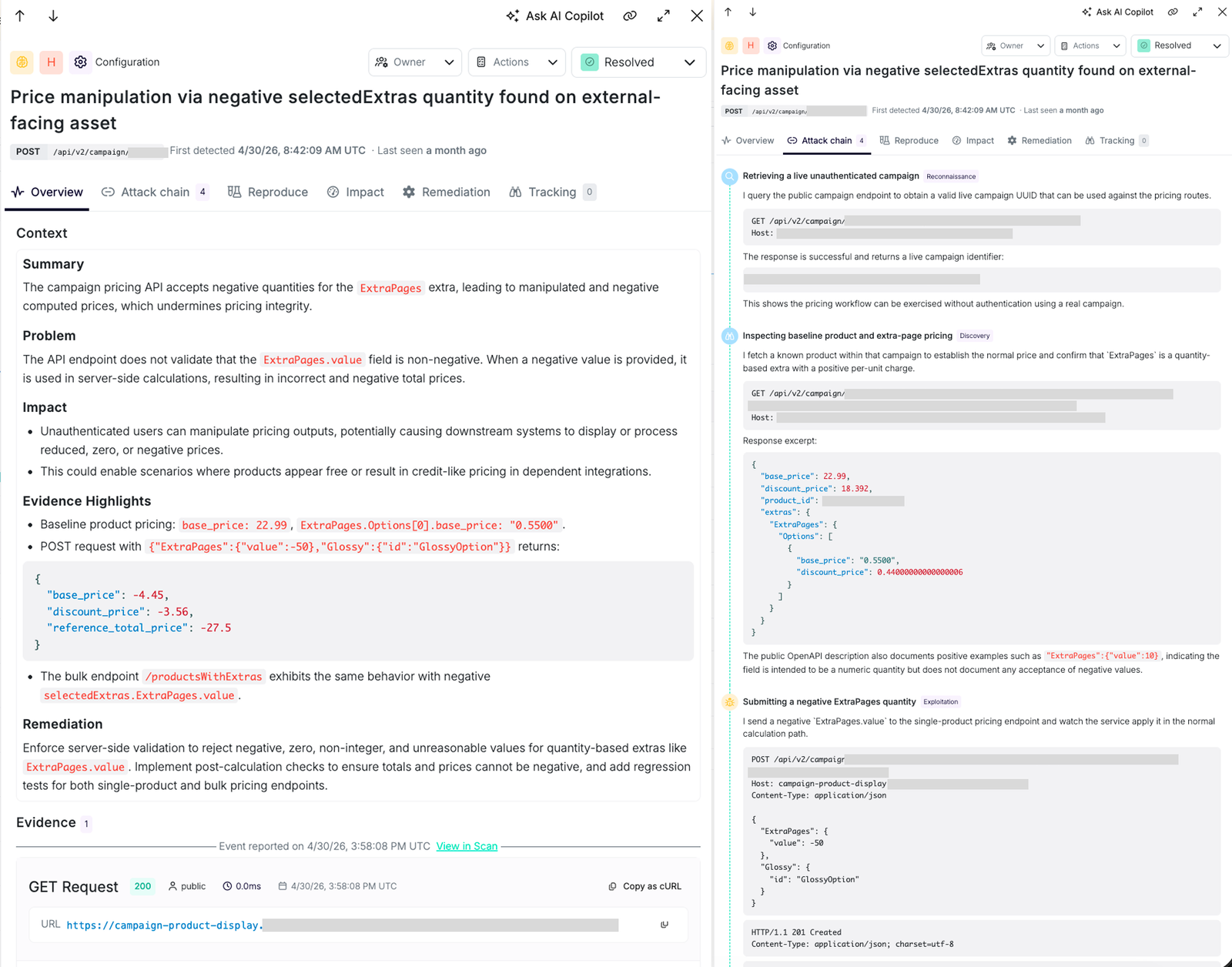
Without credentials, it does what you would expect, and confirms it rather than inferring it: exposed services, injection, SSRF, broken authentication, business logic that can be driven from a public endpoint. In one production engagement, Cascade pulled a live campaign identifier from an unauthenticated internet-facing endpoint, fetched a real product to establish its normal price, worked out that an add-on field was charged per unit, and then submitted a quantity of negative fifty to the pricing API. The public API documentation only ever showed positive examples. Nothing was unpatched and no control failed. The endpoint did precisely what it was written to do.
With credentials it reaches a layer that initial-access testing has no reason to look at. Escape's research team found this in Keycloak, the identity platform a large share of enterprises run their access management on. A restricted admin, an account deliberately scoped to a narrow slice of the user directory, asks the main users endpoint for a list and gets correctly filtered results. It then asks the endpoint that lists a role's members, where the same filter is never applied, and receives everyone's email address and full name.
Same authenticated user, same permissions, two endpoints that disagree about what they are allowed to return. Every request well-formed, every response a 200. Nobody broke in. It is now CVE-2026-17059.
That flaw grants no initial access, which is why a platform built around attack paths has no reason to hunt for it. Keycloak got a CVE because it ships to thousands of organisations. The identical flaw in your own application gets nothing: no advisory, no patch, no version to match, because nobody else runs your code. Which is exactly why scanners miss this class of bug.
If your last three critical findings were exploitable entry points, Pentera is answering the right question. If they were authorization failures, it is not.
Side by side
Escape and Pentera answer different questions about the same estate. Pentera proves how an attacker gets in and how far that access extends, across internal networks, cloud identity and the external perimeter. Escape proves what an external attacker or an already-authenticated user can reach (which is where broken object level authorization and tenant isolation failures live) that they should not. The two overlap on external perimeter testing and diverge everywhere else.
| Capability | Escape | Pentera |
|---|---|---|
| Question answered | Escape answers what is exploitable in the application, with or without credentials, including what an authenticated user can reach that they should not. | Pentera answers whether an attacker can get in, and how far that access extends. |
| Web application testing | Escape tests web applications from inside authenticated sessions, across multiple user roles in parallel. | Pentera tests web applications as an entry vector, using OWASP Top 10 targeted testing and AI-generated payloads. |
| Unauthenticated application exploitation | Escape proves injection, SSRF, broken authentication and business logic reachable from public endpoints, each confirmed with the request that worked. | Pentera proves exploitable entry points including OWASP Top 10 classes, chained into validated attack paths. |
| Continuous AI pentesting of web apps and APIs | Escape AI pentesting models how each application behaves across roles, sessions, and states, then reasons about where that logic breaks, running on every change. Once a vulnerability is found, or through bug bounty program submissions, Escape enables regression testing across the full application scope and on every build. | Pentera applies AI to adapt payloads to the system and authentication model it encounters from external attack surface, within scheduled or continuous validation runs. |
| Authorization flaws: BOLA, IDOR, tenant isolation | Core Escape capability, tested across roles, sessions and application states. | Not publicly documented in Pentera Surface or Core materials. |
| Single-page applications | Escape models client-side routing and application state in React, Vue and Angular front ends. | Pentera tests APIs as internet-facing services. GraphQL is not documented as a distinct capability. | AI and LLM Surfaces | Escape tests chatbots, AI assistants, RAG endpoints, code-generation services | Not documented by Pentera as a capability. |
| API coverage | Escape covers REST, GraphQL, with GraphQL tested against the schema rather than as a single POST endpoint. | Pentera tests APIs as internet-facing services. GraphQL is not documented as a distinct capability. |
| Internal network lateral movement | Escape does not test internal network lateral movement. | A core Pentera strength, including credential cracking, privilege escalation and Active Directory password assessment. |
| External network pentesting | Escape runs continuous discovery from cloud accounts, DNS and IP ranges, around 4,000 TCP ports per host, 170,000+ CVEs rebuilt daily, and confirms default credentials by successful login. | Pentera runs the same outside-in discovery and exploitation, with attack path visualisation proving the full chain to remote code execution. |
| Ransomware emulation | Escape does not offer ransomware emulation. | Pentera includes ransomware resilience testing inside the network. |
| Evidence provided | Escape provides the exact request sequence, default credentials confirmed by a successful login, and rendered proof of the response. | Pentera provides a validated attack path with MITRE ATT&CK kill chain visualisation. |
| Remediation output | Escape attaches a framework-specific code fix to every finding. | Pentera offers risk-prioritised remediation orchestration through Pentera Resolve. |
| Ownership routing | Escape maps every asset to the team, brand or subsidiary that stood it up. | Pentera attributes findings to the infrastructure and asset rather than the owning team. |
| Testing cadence | Escape runs continuously or on change, plus per-build inside CI/CD pipelines. | Pentera runs continuously or on scheduled runs, from daily through monthly. |
| Deployment model | Escape is agentless and needs no credentials for external testing. | Pentera is agentless with no endpoint installation required. |
| GraphQL support | Escape provides purpose-built GraphQL security testing. | Not documented by Pentera as a distinct capability. |
Compiled from each vendor's published product documentation, August 2026. Pentera revised its Surface product page on 4 August 2026 to add web application testing claims. Verify current scope before relying on any row. Last reviewed 19 August 2026.
Where Pentera wins
Internal network validation. Credential cracking, lateral movement, privilege escalation and domain compromise inside the LAN. Escape does not do this for now. If your threat model centres on an attacker already inside the perimeter moving toward a domain controller, Pentera is built for exactly that and Escape is not a replacement.
Perimeter breadth. Pentera Surface covers more entry surface than Escape does. Leaked credentials from dark web and paste sites, validated by testing whether they actually work. Phishing emulation. VPN interfaces.
Consolidating findings from other tools. Pentera ingests and prioritises alerts from adjacent cloud security, SCA and endpoint platforms, scoring them against asset criticality and environment. That is closer to exposure management than continuous penetration testing. If your problem is an alert backlog across several scanners rather than untested attack surface, it is a genuine capability.
Ransomware readiness. Safe emulation of real strains inside the network to show how they would propagate.
Board-level risk communication. Kill chain reporting mapped to MITRE ATT&CK translates technical exposure into executive narrative better than most tooling in the category.
Low operational burden. Agentless deployment, minimal configuration, quick time to first run. Consistently reflected in practitioner reviews.
Where Escape wins
Exploitability proven at both ends of the session. Escape confirms unauthenticated exploitation the way any serious application testing does, with injection, SSRF, broken authentication and business logic driven from public endpoints, each proved by the request that worked rather than a version that matched. That part overlaps with what Pentera does at the perimeter.
Authorization logic across roles. This is the structural difference, and it sits on top of the above rather than instead of it. Testing an application for initial access asks whether the login can be bypassed, whether inputs are sanitised, whether a known CVE is exploitable. Escape also asks a question that has no initial-access answer: given a valid session as a low-privilege user, what does the application actually let that user reach? It runs multiple authenticated identities in parallel and compares what each role reaches against what it should, which is the only reliable way to surface BOLA, IDOR, privilege escalation between roles and tenant isolation failures.
Coverage across every shape a modern application takes. Web applications, single-page apps where routes are assembled client-side and a link-following crawler sees a fraction of the surface, REST, GraphQL tested against the schema, gRPC, and the undocumented endpoints nobody wrote down. One platform rather than three tools meeting in the middle.
Your entire attack surface is assessed: Most AI pentesting tools focus on exploitation, but the best exploit agent is useless if it misses half your application. Coverage is what separates a real security assessment from a lucky scan. A dedicated discovery agent systematically maps your entire scope before exploitation begins, feeding everything back into the platform context so no endpoint, page, or asset is left untested. During the exploitation phase, coverage gaps are actively monitored and closed in real time. And unlike black-box tools that leave you guessing what was actually tested, Escape makes coverage fully auditable: every API endpoint, webpage, and asset discovered is surfaced in the results, so you can see exactly what was assessed, and confidently attest to it.
Authentication that defeats other tools. MFA, SSO, OAuth flows, rotating tokens, custom header schemes and sessions that expire mid-test. Coverage is worth nothing if the scanner logs out after four minutes and reports a clean run.
AI agents already running in production. Prompt injection, guardrail bypass and system prompt disclosure. Escape's engine got past a live prompt-injection guardrail on the second attempt, not with a stronger payload but by reframing the request after reading why the first one was blocked. The agent returned its full tool list, its operating rules and session identifiers.
That last example is worth sitting with, because it shows a real difference in how the two engines work. Pentera's AI generates payloads adapted to the system and authentication model it encounters. That is adaptive payload generation, and it is genuinely useful. Cascade changed strategy after a failure, treating a refusal as information rather than a dead end. Both are legitimately AI. They are not the same capability, and the second is what finds flaws nobody has written a payload for.
External network pentesting that keeps pace with the estate. Escape rebuilds your internet-facing footprint continuously from cloud accounts, DNS and raw IP ranges, rather than testing a scope someone defined at the start of a run. Around 4,000 TCP ports per host across web services, databases, remote access protocols and message brokers. Over 170,000 CVEs matched against detected versions and rebuilt daily, so something published this morning is checked today. On exposed databases and SSH, a default credential is only reported once a login has actually succeeded, which is the difference between a finding an engineer fixes and one they argue with. New acquisition on Monday, mapped and tested by Tuesday, without anyone filing a ticket.
Findings that reach an owner with a fix. Every asset maps to the team, brand or subsidiary that stood it up, based on project tags or the originating repository. The finding carries the exact request sequence, a stack-specific code fix, and a retest that confirms it closed. Asset context flows into Wiz so perimeter risk lands where triage already happens.
Pentesting as a pipeline gate. Public API, CLI and CI/CD integration. Confirmed exploits become regression tests that run on every build, so the same vulnerability does not ship twice.
The pattern that works
Most teams do not end up choosing. They end up scoping correctly.
Organisations with substantial on-prem infrastructure keep Pentera for internal network validation and perimeter breadth, and add Escape for application authorization testing, the API estate and AI agents. The overlap is smaller than the category names suggest, which is the point. You are not buying two tools that do the same thing. You are covering two questions that were previously answered by one tool and an assumption.
Organisations that are cloud-hosted and API-driven, with little internal infrastructure worth moving laterally through, more often replace. In that shape, a large part of what Pentera validates is a layer that no longer carries the risk.
How to test the difference in a POC
Do not just compare feature lists in your success criteria. Add the following process to it:
- Pick one application with a real authorization model. Multiple roles, tenant boundaries, an admin view, something with an object ID in an API path.
- Scope both platforms to it.
- Give both a valid low-privilege account. This step matters, and it is the one teams skip.
- Count findings in three buckets: exploitable entry points, authentication weaknesses, and cases where the low-privilege account reached data belonging to another user or tenant.
- For each critical, ask what evidence you got and whether an engineer could act on it without a follow-up meeting.
See the differences in a technical demo
No slides. The demo walks through real findings in the platform: how the external perimeter is discovered and confirmed, what an unauthenticated exploit looks like with the request that worked attached, and then the part this article is about, a finding where a low-privilege account reached something it should not have, with the full request sequence and the code fix.
If it looks like a fit, the next step is a POC against your own applications, which is where the comparison actually gets settled. Scope one application with a real authorization model and a low-privilege test account. If Pentera is your incumbent, run both and count findings in the authorization bucket. Book a demo
FAQ
Is Escape a Pentera competitor?
Partly. Escape and Pentera overlap on external perimeter testing, where both discover internet-facing assets and prove exploitable exposure without credentials. They diverge after that. Pentera goes inward, proving how far an attacker's access extends across the internal network. Escape goes deeper into the applications themselves, testing web apps, SPAs, REST, GraphQL and AI agents from inside valid sessions as well as from outside.
Does Pentera test web applications?
Yes. Pentera Surface includes AI-based web attack testing, and Pentera Core includes OWASP Top 10 targeted testing, with payloads adapted to the authentication model encountered. What Pentera does not publicly document is authorization testing across multiple authenticated roles, which is where BOLA, IDOR and tenant isolation failures are found. Those flaws grant no initial access, so they fall outside the attack-path model.
Can Escape replace Pentera?
For teams whose estate is cloud-hosted and API-driven, often yes. Escape covers the external perimeter with proof of exploitability, tests the applications behind it both unauthenticated and from inside valid sessions, and adds SPAs, GraphQL and AI agents. For teams whose risk is lateral movement inside an internal network, no. Escape does not test internal Active Directory paths, run phishing emulation or emulate ransomware, and the two should run alongside each other.
What kind of vulnerabilities does Escape find that Pentera does not?
Authorization flaws that appear only from inside a valid session. Escape's research team found one in Keycloak, where a restricted admin gets correctly filtered results from the main users endpoint but receives everyone's email address and full name from the endpoint listing a role's members. Same account, same permissions, two endpoints disagreeing about what they may return. It is now CVE-2026-17059. Flaws of this class grant no initial access and produce no foothold, so they fall outside the attack-path model Pentera is built around, and no scanner signature catches them because in a bespoke application there is no shared component to assign a CVE against.
Does Escape only test authenticated flaws?
No. Escape proves exploitability without credentials too, covering injection, SSRF, broken authentication and business logic that can be driven from public endpoints. In one production engagement Cascade pulled a live campaign identifier from an unauthenticated endpoint, established a product's real price, worked out that an add-on field was charged per unit, then submitted a negative quantity to the pricing API. The multi-role authorization testing sits on top of that unauthenticated coverage rather than replacing it.
Does Escape test AI agents and LLM features?
Yes. Escape tests production AI agents for prompt injection, guardrail bypass and system prompt disclosure. In one production assessment the engine got past a purpose-built prompt-injection guardrail by reframing a blocked request, and the agent returned its full tool list, operating rules and session identifiers. Pentera does not document AI agent testing as a capability.
Which is better for compliance evidence, Escape or Pentera?
Both produce continuous testing evidence with full finding history. Escape carries a first-seen date, the proof, the remediation and the confirmed retest for every issue, exportable via API. Pentera produces executive and compliance reporting mapped to MITRE ATT&CK. Where a standard requires an approved scanning vendor or a human-attested engagement, either platform runs alongside that requirement rather than replacing it.
Want to learn more? Discover the following articles: