Escape - Application Security & Offensive Security Blog
Explore practical offensive and application security insights covering web application testing, emerging AI cybersecurity research, API and GraphQL security, and advanced testing techniques.

Filters
Agentic Pentesting
Introducing Cascade Iguazu: multi-agent AI pentesting you can audit
Introducing Cascade Iguazu: version 2 of our pentesting engine Cascade. Now with a scheduler-driven multi-agent architecture ensuring consistent, repeatable runs, complete coverage, and a fully readable trail of what happened.

4 min read
Security Research
Jev and the Future of AI Pentesting: Why the Harness Matters More Than Ever
Were we wrong to use LLMs & Agents for security?
Security professionals are fully embracing agents for security workflows, from finding vulnerabilities in code to investigating and triaging security issues. And for good reason: many of these tasks require complex reasoning and the ability to understand how applications work.
But

10 min read
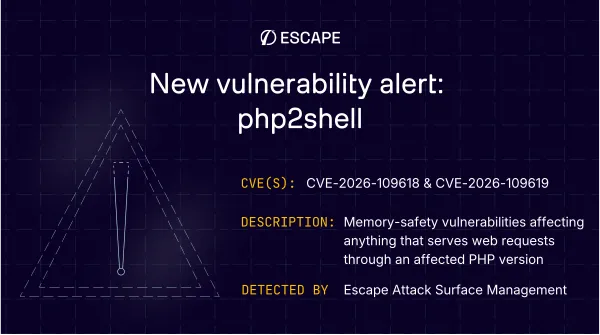
php2shell (CVE-2026-109618 + CVE-2026-109619): unauthenticated RCE in PHP core, now detected by Escape
php2shell is a pair of critical memory-safety vulnerabilities in the PHP engine itself, tracked as CVE-2026-109618 and CVE-2026-109619. Escape detects affected PHP versions across your attack surface and shows you every exposed asset that needs the patch.
php2shell is not a WordPress bug, a Drupal bug, or a bug in

8 min read
Launching AI Red Teaming: pentest your AI agents and MCP servers all alongside your app
Developers are standing up AI agents and MCP servers faster than security can test all the data flows they introduce, and often faster than anyone can agree on the guardrails. Layer on the APIs behind them and you have a whole new attack plane.
The use of AI systems in
4 min read
Compliance
Compliance penetration testing requirements, by framework
Introduction
Your auditor wants your latest pentest report to close a control. That same week, a prospect's security team asks for the same PDF before they'll sign. The good news is that the penetration testing requirements behind both mostly agree on timing, and this guide to

17 min read
Offensive Security
What continuous offensive security testing is and how to implement it
Introduction
Continuous offensive security testing (COST) is a model for running adversary-style tests whenever something material changes, such as a release, a new internet-facing asset, or a change to a security control.
Instead of the standard once a year test, Gartner introduced COST as a term to describe this trigger-driven

20 min read
Product updates
Driving efficiency in pentesting: new features live in Escape
Offensive security teams are covering more dev teams every quarter without their own headcount growing to match. Their roles continue to be forced into project management and firefighting instead of finding the vulnerabilities that get them speaking spots at conferences.
Our latest batch of features removes manual steps that eat
3 min read
AI pentesting
AI pentesting: what it is, and what it can actually find
Scanner with a chatbot
A real AI pentest
Login
Stops at the login page
Authenticates and tests behind it
Identities
Tests as one user
Holds several at once
Findings
A list it never reproduced
Every one reproduced before it files
13 min read

AI pentesting
What an external penetration test is and how one is actually run
Starts from
Asks
You get back
External pentest
The public internet, no access
Can an attacker get in at all
A demonstrated way in
Internal pentest
An assumed foothold
How far they get once inside
A lateral-movement path
Vulnerability scan
An asset list you supply
Is any known issue present
15 min read
Pentesting
How to build a continuous pentesting program
Introduction
An unpatched flaw is now the most common entry point for a breach, at 31%, ahead of stolen credentials at 13%, and the median time to fix one has crept up to 43 days (Verizon's 2026 DBIR). So an annual pentest is always a step behind, and
10 min read
Case Study
How Amp got its SOC 2 type II pentest evidence in hours
Amp is building the AI hiring team for frontline employers. Compliance was in the product from day one, which meant a pentest in year one. Here is how they scoped it, ran it in hours with Escape, and made sure they're ready for their SOC 2 Type II audit.

7 min read

Offensive Security
Escape found the same XSS in two AI chatboxes. The vulnerability was in the Markdown renderer.
Weeks apart, at two unrelated companies, Escape's AI pentesting agent found the same stored XSS. Both had shipped a customer-facing chat where the model emits Markdown and the frontend renders it with raw HTML enabled and no sanitizer, so anything the model can be made to say executes


8 min read
Offensive Security
Horizon3.ai alternatives in 2026: Escape vs NodeZero and 4 more tools
Escape is the best Horizon3.ai alternative for continuous AI pentesting across APIs, web apps, and complex authentication, including regression testing, developer-ready remediation, and platform pricing suited for rapidly scaling orgs.
21 min read
Announcement
Introducing Escape's Channel Partners
After announcing our channel partner program last month, we are excited to now be working with eleven incredible partners, with more soon to join us!
Escape's Channel Partner Program is built on a simple principle: a two-way relationship centered on the shared goal of helping security teams do
5 min read
Offensive Security
Escape vs Pentera: how each one proves exploitability (2026)
Most teams arrive at this comparison with the wrong framing: two automated penetration testing platforms, pick one.
Start with what Pentera actually is, because the comparisons that skip this get everything after it wrong. Pentera is an exposure validation platform with a key focus on network testing, and a good
14 min read
Offensive Security
Pentera Alternatives for Continuous Pentesting: 7 Competitors Compared In-Depth
Most security and IT teams we talk to who are evaluating Pentera alternatives are mostly happy with what Pentera does. What changed is the shape of the problem underneath them. It used to be a network problem. Now it is also a web application problem, and the tool hasn'
21 min read
Competitor Comparison
Escape vs StackHawk: full DAST comparison 2026
Last updated: August 2026. StackHawk's positioning changed materially in December 2025 with the launch of Business Logic Testing for APIs (Cross-profile BOLA/BFLA only), and again through 2026 with coding-agent integrations. This comparison reflects those changes.
20 min read
Research
AI vs AI: How Cascade exploited an AI agent in production
We pointed Cascade, Escape's AI pentesting engine, at a production AI agent. The agent had a guardrail built to catch prompt injection. Cascade got past it on the second try.
The trick wasn't a smarter payload, just a different pretext, and the agent handed over its
4 min read
Application Security
Authenticated scanning behind OAuth, MFA, and CAPTCHA
Authenticated vulnerability scanning reaches where your real risk lives, behind the login, and it is the kind of security scanning most tools fail at.
A scanner hits the OAuth redirect, the MFA prompt, or the CAPTCHA, falls back to crawling as an anonymous visitor, and still finishes green, so the
10 min read
Offensive Security
Continuous penetration testing: what it means when the testing never stops
In late 2025, Anthropic disclosed the first documented cyberattack run largely by AI, a state-linked group that used Claude Code to run 80 to 90 percent of an espionage campaign on its own, at thousands of requests a second.
Offense now moves at machine speed while most defenses stay scheduled
10 min read
Offensive Security
Penetration testing as a service (PTaaS), explained
Penetration testing as a service (PTaaS) made buying a pentest almost frictionless. You scope it in a portal, watch findings land on a live dashboard, and click a button to retest the fix, all without a single procurement call. But the test still runs on a schedule, so weeks after
10 min read
Announcement
Escape joins Anthropic’s Cyber Verification Program to advance AI-powered offensive security
Good news doesn't arrive alone. This month we joined not one frontier AI program but two! Yesterday we shared that Escape joined OpenAI's Trusted Access for Cyber. Today we're a verified member of Anthropic's Cyber Verification Program.
Both programs solve the same
2 min read
Announcement
Escape joins OpenAI’s Trusted Access for Cyber (TAC) to advance AI-powered offensive security
We've been approved for OpenAI's Trusted Access for Cyber preview.
For years we've been building toward one idea: offensive security that runs continuously inside engineering, instead of arriving twice a year as a PDF nobody reads past the executive summary. Business-logic DAST first, then
4 min read
Don’t let your vulnerabilities escape.
Ready to multiply your force, not just noise?
Book a demo
Book a demo