



Continuous external network pentesting
Escape the once-a-year external pentest.
Continuous testing of everything reachable from the internet. Every host, port and exposed service, probed the way an attacker would, with proof of what's exploitable, the name of the team that owns it, and a retest that confirms it closed.
Trusted by 2000+ security teams worldwide





Attacker's-eye testing, running continuously.
An external network pentest answers one question. What could someone outside your network, with no credentials and no internal access, get through? Escape answers it continuously, and carries every finding through to a confirmed fix.
/01
Discover
See what's actually reachable
Escape rebuilds your internet-facing footprint from your cloud accounts, DNS and raw IP ranges, then scans it with no credentials and no agents, like an outsider would.
/02
Validate
Prove it, don't flag it
A version match is a hypothesis. Escape confirms the service is reachable and the weakness is real before it wastes your team's time:
- Proof of exploit with the exact request sequence
- 170,000+ CVEs matched on detected versions, rebuilt daily.
- On exposed databases and SSH, default credentials are confirmed by a successful login
- Chained misconfigurations tested the way an attacker would combine them
- Proof of exploit with the exact request sequence
- 170,000+ CVEs matched on detected versions, rebuilt daily.
- On exposed databases and SSH, default credentials are confirmed by a successful login
- Chained misconfigurations tested the way an attacker would combine them
/03
Attribute
Attach the business context
This is the part that decides whether anything gets fixed. So every exposed asset carries the context that settles it: where it was found, which region and business unit owns it, what environment it lives in, whether it should be public at all.
Criticality scored on real exposure, so the queue is ordered by risk.
Multi-brand org? Findings route themselves to the right team, brand or subsidiary.
Criticality scored on real exposure, so the queue is ordered by risk.
Multi-brand org? Findings route themselves to the right team, brand or subsidiary.
/04
Remediate
Fix, retest, keep the record
The finding goes to the person who can act on it, with a fix attached, and Escape re-tests to confirm the door is shut.
Every external tool will find the exposed host. What decides whether it gets fixed this quarter or next year is another story.
context, not just coordinates
An IP address is not a finding
〜4000
TCP ports scanned on every discovered host, spanning web services, databases, remote access protocols, message brokers, and more
Every external tool finds the exposed host. Escape tells you whether an attacker can actually get through and the exact action needed to close the exposure. It then routes the finding to the right team, brand, or subsidiary and retests it to confirm the exposure is gone.
YOUR SCALE IS NOT THE LIMIT
Your org scales. Your external network pentesting scales with it.
<1h
to map an entire external attack surface, including one you inherited last week
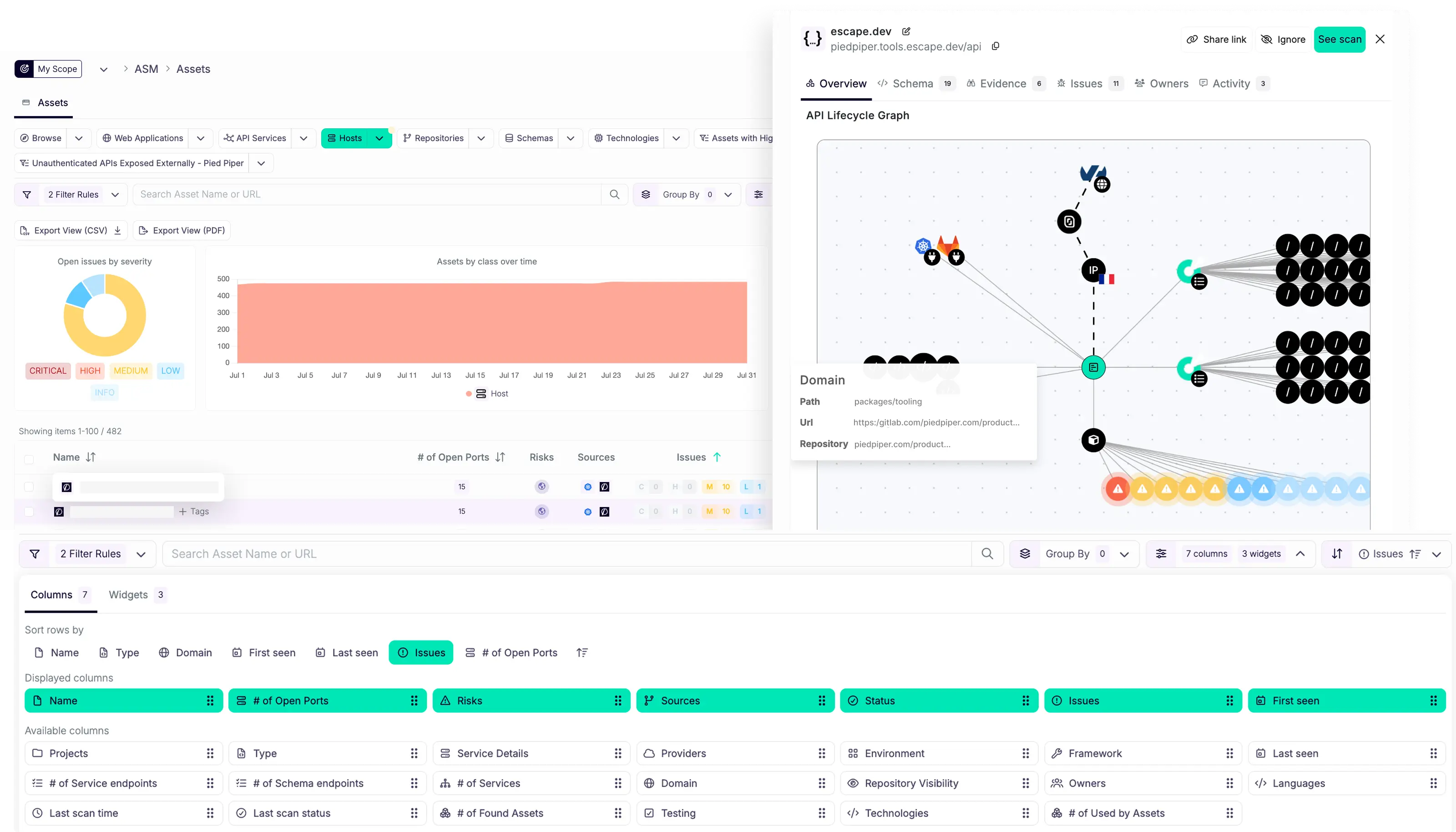
New acquisition, new product line, new team onboarded next quarter, sound familiar? Through powerful integrations, public API, command line tooling, and custom reporting you can automate the security onboarding and risk reduction that used to take months.
Every new asset and associated risk is discovered, attributed, scanned, prioritized and routed without anyone filing a ticket.
Every new asset and associated risk is discovered, attributed, scanned, prioritized and routed without anyone filing a ticket.
.webp)
AND MUCH MORE
The details that turn external pentest into action.
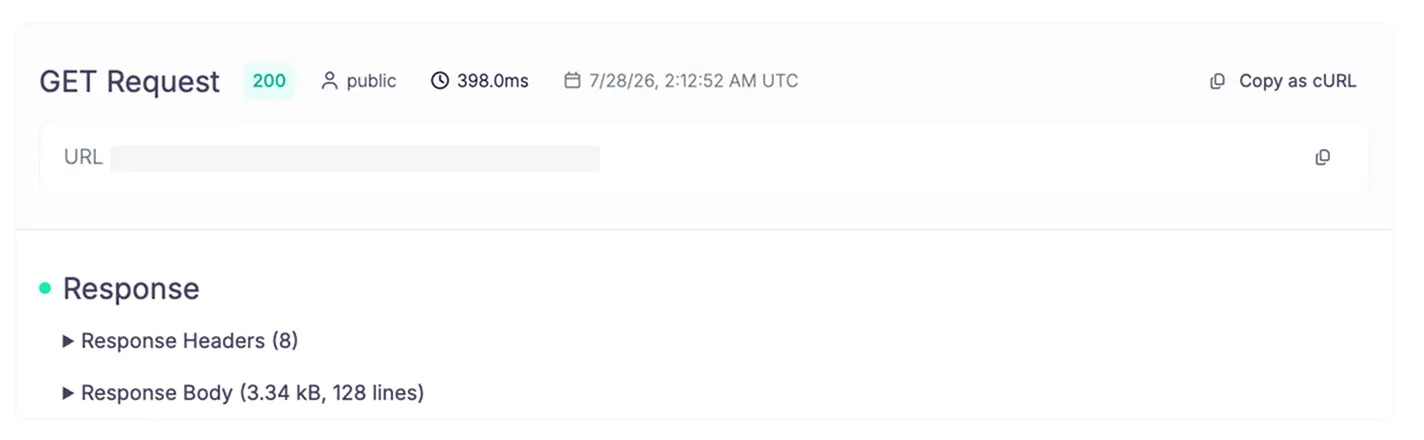
Every finding shows the exact sequence that reached the service, so nobody argues about whether it is real. The action that closes it comes attached.
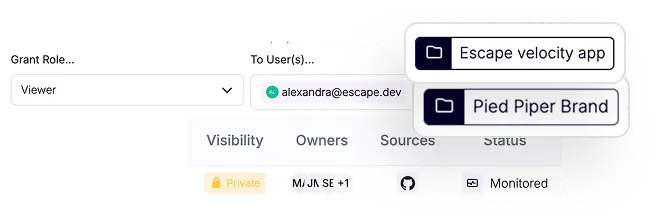
Every host is mapped to the team or brand that stood it up, based on the project tags you set or its code repository. You can route the fix directly to the right owner instead of asking, “Who owns this?”

Every exposed asset flows into Wiz with owner, type and exposure level attached, so perimeter risk lands where your team already triages it.



ready to pentest your external network assets?
Schedule a call with one of our experts
Plenty of tools test a perimeter. The difference shows up in what happens after the finding.
vs. annual manual pentest engagements | vs. discovery-only attack surface tools | vs. network-only autonomous pentest | ||
|---|---|---|---|---|
Coverage | Everything internet-reachable: hosts, IPs and CIDR ranges, ports and services, TLS, DNS, exposed staging and admin. Rediscovered continuously, so the scope is never a stale list. Application layer covered additionally. | Deep where a human looks, but bounded by the scoped list and the tester's hours | Inventory only. Maps what's exposed, doesn't test it | Strong on hosts, ports and services. Scope is set per run, so coverage is only as fresh as the last launch. |
validation | Proof of exploit with the exact request sequence. On exposed databases and SSH, default credentials confirmed by a successful login. | Proof arrives in a PDF, weeks after the test. | No exploitation: flags exposure, can't confirm it's reachable | Proves network attack paths; but not application-layer exploitability. |
Business context | Every asset mapped to its business unit, plus the environment and criticality behind the IP. | The tester doesn't know your org or brand chart. Attribution lands back on your team. | An inventory row, and sometimes a WHOIS guess. | Attributed to infrastructure, not to the team that owns it. |
remediation | Tailored code fix, routed to the business unit owners; flows into Wiz, tickets and the IDE | A report your team re-triages and re-routes by hand. | A list. Ownership and the fix are your problem. | Infra-level guidance, no code fix, no mapping to the owning team. |
Scale | Highly scalable for large, distributed environments. | Point-in-time. | Scheduled scans. | On-demand runs you have to launch and scope each time. |
CADENCE | Continuous, or triggered on change: new exposure surfaces as it appears. | Consultants need VPN access, NDAs and standing network exposure. | Mostly external; internal needs its own agent. | Needs a scanner deployed inside the network. |
Evidence
Continuous testing produces its own paper trail
External testing gets audited, whether by a regulator, an insurer or a customer's security questionnaire. Running it continuously means the evidence is already there when someone asks. Where a standard requires an approved scanning vendor, Escape runs alongside that scan and covers the other fifty-one weeks of the year.
on your cadence
Scheduled scans on whatever interval your policy requires, and after every significant change to the perimeter.
full finding history
Every issue carries a first-seen date, the proof, the remediation and the confirmed retest that closed it.
exportable
Reports and a public API, so findings and asset context flow into your internal tooling and into Wiz.
fixes, not findings
Show an auditor a closed loop per subsidiary with dates, rather than a PDF of open issues from last spring.
Don't take our word for it
What security teams say after getting full visibility on external attack surface.
“Within about an hour, we had all our API attack surface scanned and we were able to determine if there were any vulnerabilities on any of our endpoints because in stark comparison with previous vendors where it’s difficult to onboard and you don’t get good results very quickly.”
.jpeg)
Michael Bourgault
Sr.Security Architect
Sr.Security Architect

"As a global organization with a diverse digital footprint, we take advantage from Escape's platform to continuously improve the discovery and assets tracking across our entire group — including shadow IT — and to monitor our public exposure."

Cyber Security Attack Surface Team Leader

Seamless docking. Every pentest mission.
Deploys into what you already run.
Escape connects to the infrastructure and workflows you have today.
Discovery pulls from your cloud and repos, findings land in your tracker, and asset context flows downstream into the risk platform your team already looks at.
Discovery pulls from your cloud and repos, findings land in your tracker, and asset context flows downstream into the risk platform your team already looks at.
modern frameworks
cloud environments
security tools
developer tools
Pyhton
venture further
External testing is the entry point, not the whole map.
Here is everything you need for continuous offensive security.
Business-logic-
aware DAST

Replace legacy DAST with business-logic-aware testing that improves over time and helps your team remediate real, exploitable vulnerabilities.
Attack Surface Management

Discover and validate exposure of modern applications, APIs, and infrastructure
from code to cloud.
from code to cloud.
AI
Pentesting
Pentesting
Escape helps teams scale down exploitable risk, not just scale pentest output.
Don't let your perimeter escape
See everything reachable from the outside and what an attacker could do with it in under an hour.
Book a demo
Book a demo