Penetration testing as a service (PTaaS), explained

Penetration testing as a service (PTaaS) made buying a pentest almost frictionless. You scope it in a portal, watch findings land on a live dashboard, and click a button to retest the fix, all without a single procurement call. But the test still runs on a schedule, so weeks after it ends you get a report on a version of your app that shipped dozens of releases ago, and everything in between went out untested.
PTaaS fixed how you buy a pentest, not when your coverage runs. This guide covers what PTaaS actually is, how it compares to traditional pentesting and bug bounty, what it genuinely improved, where the coverage gap opens, and how to close it so a finding proven once keeps getting tested on every build.
TL;DR
- PTaaS fixed how you buy a pentest, not how often you're covered. It delivers the same human-led test through a platform, so you get a portal, live findings, and a retest button instead of a PDF, but it still runs on a schedule.
- Every engagement is a point-in-time snapshot, so the builds you ship between tests go unchecked. One version gets certified, everything after it waits for the next engagement. That's the actual coverage gap.
- Continuous coverage means proving a finding once, then re-testing it on every build. AI-driven pentesting proves each finding with a working exploit, and DAST should replay it on every release, so a fix stays verified instead of resurfacing at the next audit.
What is penetration testing as a service?
Penetration testing as a service (PTaaS) is a subscription model that delivers a human-led penetration test through a software platform. Instead of a one-off project that ends in an emailed PDF, you get a portal to scope and launch testing, a live dashboard of findings as they land, and a button that triggers a retest.
You buy access to a testing program rather than a single project, and some vendors write it "pentest as a service," which means the same thing. The term gets used loosely enough that two vendors can both say "PTaaS" and mean fairly different products, so it's worth pinning down what stays the same underneath and what actually changes.
Same pentest, new delivery
Underneath, the methodology is unchanged. A PTaaS engagement is still a structured assessment in which human testers probe your target system for exploitable vulnerabilities the way real-world cyber attacks would, following recognized standards.
NIST SP 800-115 lays out a four-phase methodology (planning, discovery, attack, reporting), and the OWASP Web Security Testing Guide is the community reference for how web application testing actually gets done.
Engagements commonly map technique coverage to MITRE ATT&CK and PTES as well. If you've read a pentest report before, you've read the output of those documents.
What PTaaS adds sits entirely in the delivery layer around that test.
- A portal to scope and kick off testing.
- A live dashboard showing findings as they land, instead of all at once at the end.
- A "verify fix" button that triggers a retest.
- Integrations that push results into ticketing and CI/CD.
The term describes how the test is bought and delivered, not what the test is. Underneath, it's still the same human-led engagement, human intelligence probing your app the way an attacker would.
PTaaS vs traditional pentesting vs bug bounty
If you're evaluating PTaaS, you're really choosing between three models, and they solve different problems. Traditional pentesting is a scheduled project, PTaaS is that same test delivered through a platform, and bug bounty is an open program researchers opt into on their own terms, so the real comparison comes down to cadence, scope control, and who does the testing.
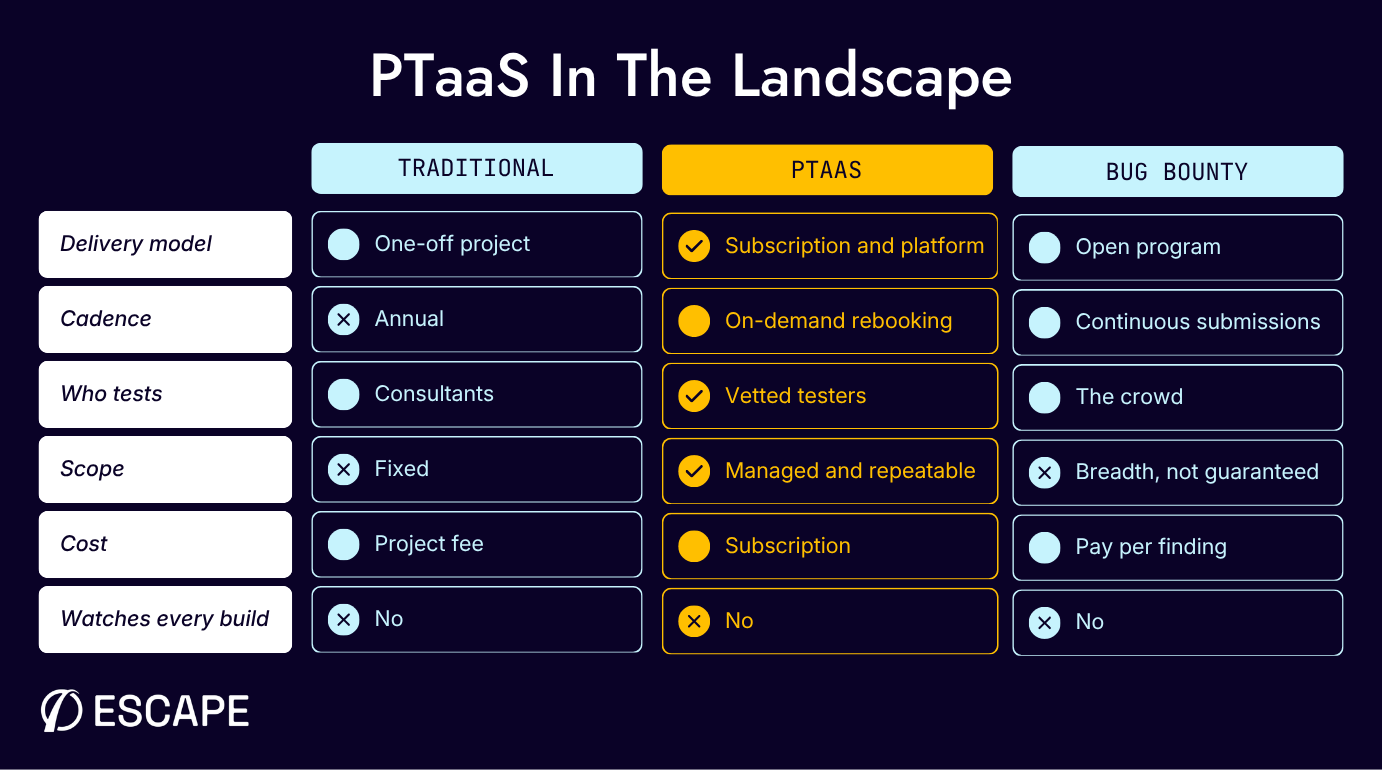
Bug bounty gets mispositioned as the continuous option more than any of the three. Researchers chase the payouts and the interesting targets, so you get breadth and creativity with no guarantee that a given release, endpoint, or authorization boundary ever gets looked at. All three fire on a schedule or an incentive, so none of them watches every build as it ships.
What PTaaS fixed, and what it left open
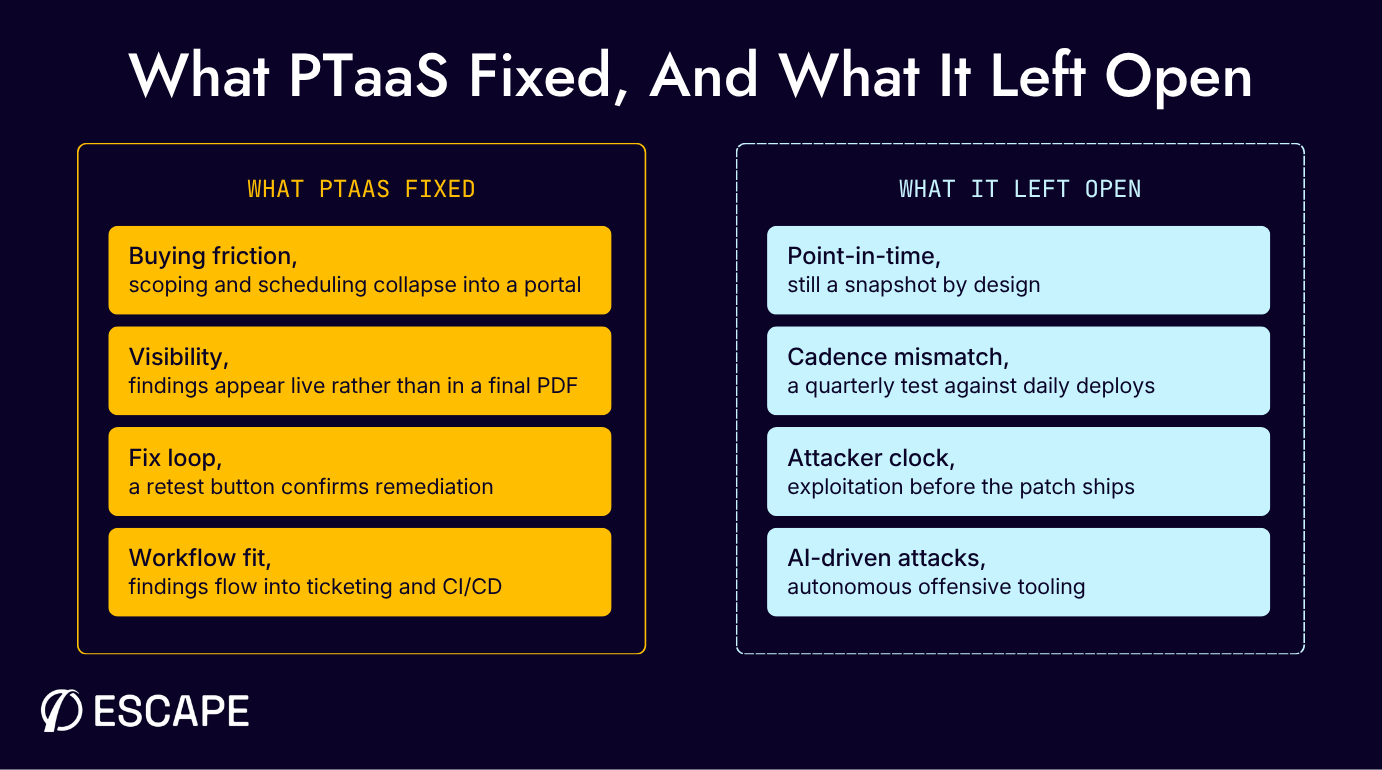
PTaaS caught on for good reasons; three parts of running a pentest- buying it, seeing findings land, and confirming fixes- genuinely got better. But a faster, cleaner report is still a report, and a report is not a program, so the coverage problem underneath stayed exactly where it was.
The procurement problem PTaaS solved
Buying a pentest used to be the slowest part of running one. Scoping calls, quotes, statements of work, and calendar negotiation could eat weeks before a tester touched anything, and the findings still arrived weeks later, in a document.
The portal, live dashboard, and retest button collapse that whole cycle. You scope the work yourself, triage a critical on day two instead of reading about it three weeks on, and confirm a remediation without booking a fresh engagement.
The integrations do the most durable work, because pushing findings into Jira and CI/CD turns a pentest result into an engineering ticket with an owner and a due date. A finding with an owner and a due date gets fixed, while a finding in a PDF gets forwarded.
The coverage problem it didn't
A penetration test is point-in-time by design, and NIST SP 800-115 structures it that way, moving through planning, discovery, and attack, with reporting running alongside, and ending in a document.
PTaaS delivers that snapshot faster and cleaner, but it's still a snapshot, and a time-boxed one that runs wide before it runs deep on the business-logic and authorization flaws that take patient, multi-user probing to reach.
Elite performers in the Accelerate State of DevOps Report deploy on demand, many times a day. Against that release rate, your attack surface is expanding at escape velocity, and a quarterly assessment is an accurate record of a version that now lives only in your git history, and the further you get from the test date, the less the report describes what's actually running.
External threats have sped up just as fast, and Mandiant's M-Trends 2026 puts the mean time to exploit at an estimated negative seven days, so attackers now exploit vulnerabilities before a patch is even released. When the fix window is measured in quarters, and the exploit window is measured in days, testing that keeps pace has to run closer to release speed than to audit speed.
Closing the gap between engagements
A point-in-time test leaves two different security gaps. It misses things because it runs infrequently (the time gap between engagements), and it misses things because a single scheduled pass stays shallow (the scope gap where business logic and authorization flaws hide). Closing both takes two matching mechanisms: continuity for the time gap and depth for the scope gap.
Prove it once, with a working exploit
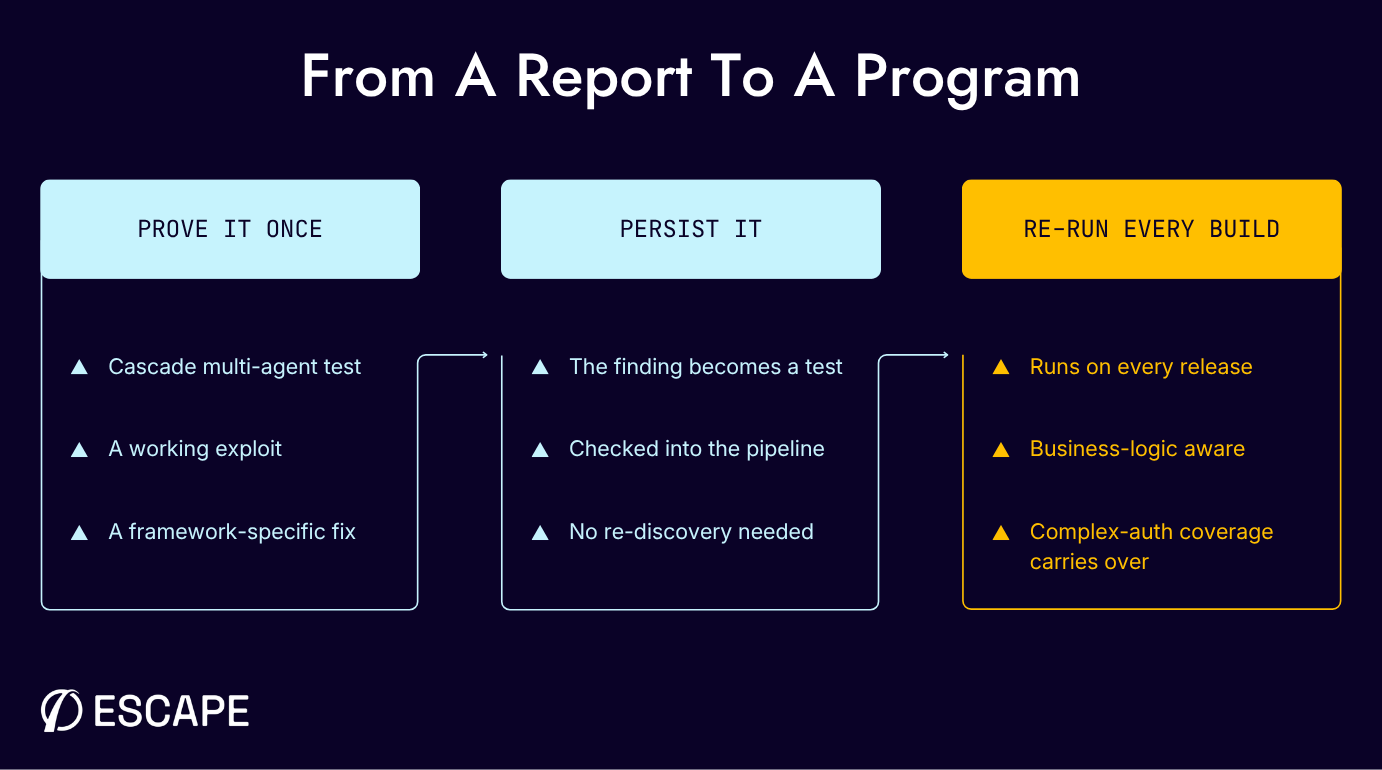
When the exploit window is measured in days, defensive testing can't afford to begin cold each quarter. A scheduled engagement starts from zero every time, spends its first days rediscovering what you run, and leaves nothing behind when it ends. Escape's AI Pentesting Cascade opens with a live model of your attack surface and keeps that context across engagements.
Cascade is a multi-agent AI pentesting engine built to uncover vulnerabilities and prove each finding with a working exploit. That proof ships with the exact request sequence, the user scopes involved, and framework-specific remediation that lands in the tools your developers already use, so your security team can address vulnerabilities instead of spending a day reproducing them before they can prioritize a fix.
Depth comes from testing the way real users exist in your app. Escape holds multiple identities in isolated sessions and tests as several users at once. That's how you uncover the sophisticated vulnerabilities single-pass scans miss, like BOLA, privilege escalation, and the authorization gaps that let one account gain unauthorized access to another's sensitive data.
A single-identity test can't even ask whether user A can read user B's order, and Escape reports that adding a second identity typically surfaces 30 to 50 percent more issues.
Coverage stays auditable because a discovery agent handles vulnerability discovery across the full scope before exploitation begins, so results show what was assessed, not only what was found. That's the honest answer to "did the test actually cover my application?"
Then keep it covered on every build
Proving an exploit is only half the mechanism, and what happens to it after the engagement is the other half. Escape's DAST takes that proven exploit chain from AI-driven pentesting and re-runs it as a regression test on every build, catching the issue the moment it reappears.
Nobody hand-writes the assertion, because the proof is the test. Cascade brings the depth, while DAST brings the continuity, enabling organizations to run the deep assessment once and keep coverage on every release.
That regression test is business-logic-aware because it replays a real proven chain, the authenticated request sequence and the authorization boundary Cascade already crossed, rather than firing a generic payload and pattern-matching the response.
It runs inside your CI/CD pipeline, wired into the software development lifecycle where your builds already run, so a boundary that passed once is re-checked on every release after it, with nobody scheduling a thing. For a small security team outnumbered by its own engineers, that's the difference between chasing every release and trusting each one is covered.
That only holds if the scanner can reach authenticated surface on every build. OAuth, MFA, TOTP, and text-based CAPTCHA are where most scanners break or quietly fall back to scanning the logged-out shell of your app, and Escape's authenticated testing docs cover each of them. In the Applied Systems case study, a complex authentication flow plus a CAPTCHA challenge had been stopping authenticated scanning.
Escape built custom authentication during the proof of concept, and per Andrew Orr Erwing, Manager of Security Engineering (AppSec) at Applied Systems, Escape's team cleared the CAPTCHA blocker in about half a day.
Conclusion
PTaaS answered how a pentest gets bought. It left the harder question open. What happens to your attack surface in the eleven weeks after the testers log off, and is a finding proven in April still being checked on the build that ships in November?
That's the gap Escape is built to close. AI pentesting proves each finding once with a working exploit, and DAST replays that exploit on every build, so coverage never lapses between engagements and a regressed fix fails the build instead of surfacing at the next audit.
Book a demo and watch a proven finding become a per-build regression test against your own stack.
FAQs
Is penetration testing as a service worth it?
For most teams, yes, as long as you pair it with continuous testing that covers the gap between engagements. PTaaS upgrades procurement, scheduling, and fix tracking for security teams, but each engagement is still a snapshot in time that can leave potential risks unseen between runs.
What is the difference between PTaaS and traditional penetration testing?
The difference is delivery, because both run a human-led assessment against standards like NIST SP 800-115 and the OWASP Web Security Testing Guide, but traditional pen testing ends in a one-off report while PTaaS delivers the same test through a subscription platform with live findings, on-demand retesting, and integrations.
What is the difference between PTaaS and a bug bounty?
PTaaS is a scoped engagement run by a contracted team on a schedule you set. Bug bounty programs are open, with independent ethical hackers picking their own targets for pay per finding, so coverage tracks their interest rather than your release schedule. Most teams run a bounty on top of structured testing, not in place of it.
Is PTaaS actually continuous?
Not on its own, because it's point-in-time by design and captures your current security posture at a single moment. A retest button speeds up the loop, but new releases and new security threats still go untested between engagements. Continuous testing means re-running proven findings as regression tests on every build.
How much does PTaaS cost?
Pricing is rarely published and gets quoted per engagement against scope, application complexity, and testing frequency. If you already spend six figures a year on manual testing, the more useful measure is coverage per dollar. How many days a year is your changing attack surface actually under test, against how many days you ship?
What types of penetration testing can PTaaS cover?
PTaaS covers the same breadth as traditional penetration testing services to identify vulnerabilities across web application and API testing, mobile apps, network infrastructure and external infrastructure, cloud penetration testing, and social engineering. Run it as black box testing, white box testing, or grey box testing. Findings span cross-site scripting, configuration weaknesses, and the authorization flaws that only surface under authenticated, multi-user testing, so cloud security matters as much as the classic network scope.
How do I choose a PTaaS provider?
Look at how PTaaS vendors balance automation and human expertise. The strongest pair automated tools for breadth with experienced pen testers, and what PTaaS vendors provide beyond a findings list matters, such as actionable reporting, vulnerability remediation, and compliance support. Confirm that real ethical hackers and offensive security experts, not only automated tools, are testing your critical assets and probing the system's defenses. Then weigh cost-effectiveness on coverage per dollar, not headline price.
How does PTaaS fit a continuous security strategy?
It's one input, not the whole security strategy. PTaaS enables teams to run on-demand testing when a release warrants it but can't track your cybersecurity posture between runs. Pair it with continuous penetration tests, where proven findings become automated testing in the software development lifecycle, to keep coverage current as emerging threats appear. Security controls, existing security measures, incident response, and response capabilities still reduce security risks day to day.
Sources
- SP 800-115: Technical Guide to Information Security Testing and Assessment - NIST
- Web Security Testing Guide - OWASP Foundation
- 2024 Accelerate State of DevOps Report - Google Cloud / DORA
- M-Trends 2026 - Mandiant / Google Cloud