A guide to network penetration testing: scope, methodology and frequency


You probably buy a network pentest because an auditor asks for one, and the report passes the audit without showing what an attacker could actually reach. Microsoft’s Digital Defense Report 2025 found exposed cloud workloads were attacked within 5.3 hours on average, so a report that only satisfies the audit leaves you guessing. In this article, we’ll cover internal and external testing, what each framework requires, and how to scope one test that satisfies the auditor and your team.
TL;DR
- Scope both sides. External testing starts from the internet. Internal testing starts from a foothold and maps what it reaches.
- Treat compliance as the floor. PCI DSS and NYDFS require yearly tests. PCI service providers test segmentation every six months.
- Follow the port to proven impact. An open port and a CVE match are leads. Require reproduction steps, impact, a fix, and a retest result.
What is network penetration testing?
Network penetration testing, also called infrastructure penetration testing, is an authorized simulated attack that checks whether security weaknesses in your network infrastructure can be combined to gain unauthorized access, cross a trust boundary, or reach sensitive data. It covers internet-facing assets and paths that begin from an assumed internal foothold.
The National Institute of Standards and Technology (NIST) describes testers who “mimic real-world attacks in an attempt to identify ways to circumvent the security features of an application, system, or network”.
Ethical hacking is hacking under a written agreement, where ethical hackers use the same tools and real-world attack scenarios as attackers. Your scope turns that broad definition into named assets, starting positions, allowed actions, and evidence requirements.
Internal network vs external penetration testing
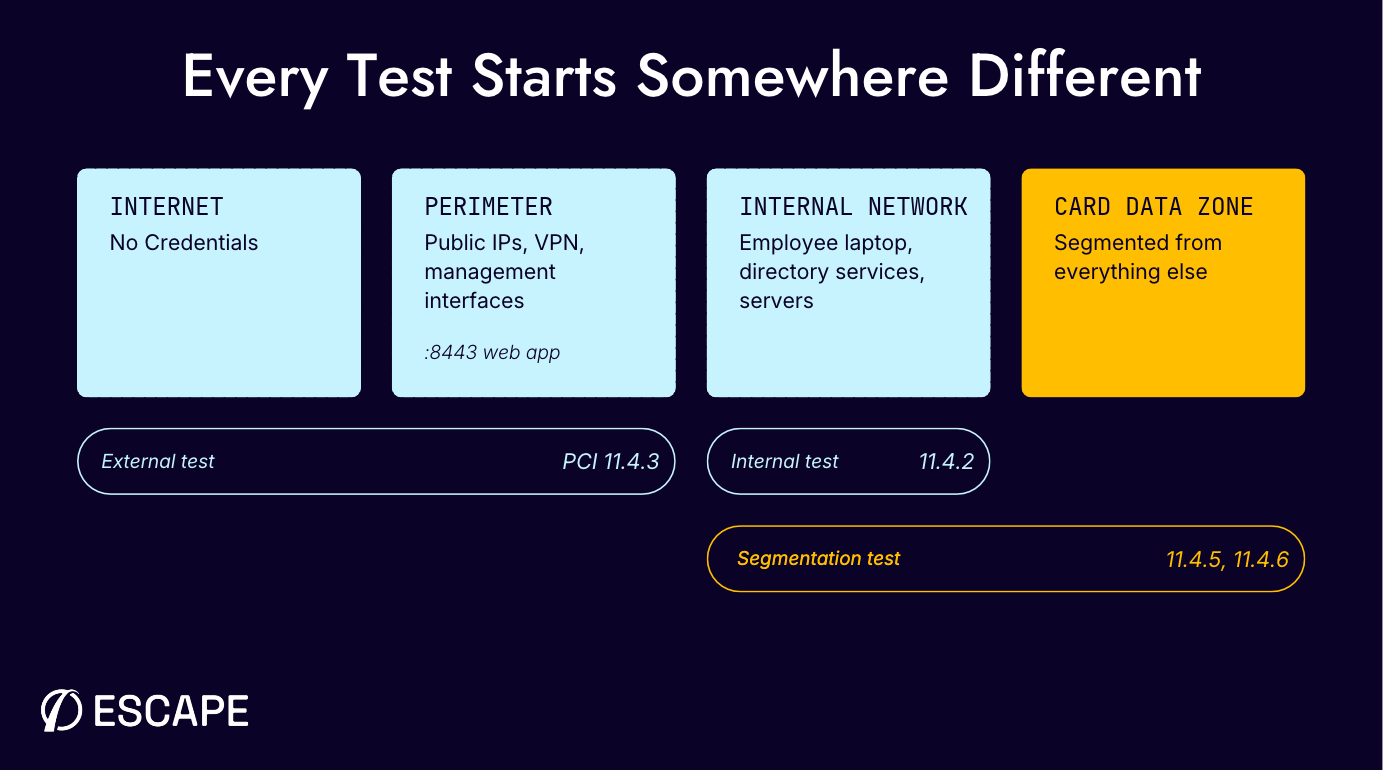
External network penetration testing starts from the internet without credentials and asks what an outsider can discover, reach, and validate. Its scope often includes public IP ranges, web servers, cloud-hosted services, remote access, exposed management interfaces, and the web applications those systems serve. Attackers often reach those entry points first, within hours of a new service going live.
An internal network penetration test starts from an agreed foothold, such as a standard employee laptop or a working VPN account. The tester checks which internal systems that account can reach, whether it allows privilege escalation or exposes additional credentials and directory attack paths, and whether a segmentation boundary prevents unrestricted access.
The Payment Card Industry Data Security Standard (PCI DSS) requires a method that includes “testing from both inside and outside the network”. External and internal describe the starting position, while network segmentation testing describes a boundary the tester tries to cross.
Black box testing, gray box testing, and white box testing
Black box testing gives penetration testers no prior knowledge of the target system, so they start where an outside attacker would. Gray box testing hands over partial information, such as a working employee account or network diagrams for one segment.
White box testing shares full details, including network diagrams, credentials, and configuration, enabling in-depth testing within a short window.
Box testing describes how much the tester knows, and it sits on top of the internal/external split, so a gray-box internal test might start with a working employee account and an approved device image.
How is a network vulnerability assessment different from a penetration test?
Vulnerability scanners check known hosts for exposed services, operating systems, outdated software, and known vulnerabilities. A network vulnerability assessment reviews those potential vulnerabilities, removes obvious errors, and ranks the remaining security risks so you can decide what needs validation.
During a network pentest, the tester attempts to validate selected findings and chain multiple vulnerabilities together. NIST SP 800-115 says most penetration tests look for “combinations of vulnerabilities” that “gain more access than could be achieved through a single vulnerability”. The report should record the scanner result, the conditions tested, the actions taken, and the access obtained.
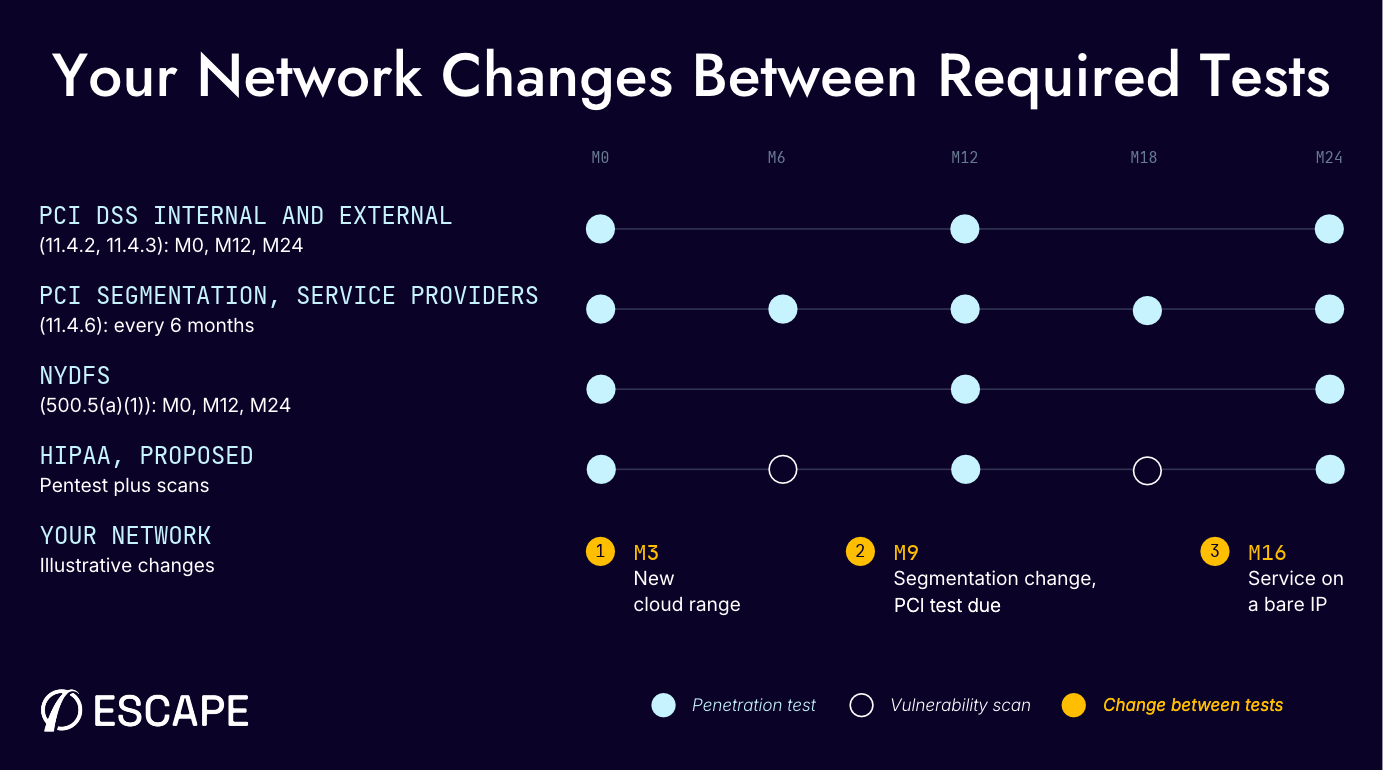
Use network vulnerability scanning often enough to catch outdated systems and new exposure. Schedule network security penetration testing based on risk, significant changes, and any applicable compliance dates. The proposed HIPAA rule reflects the distinction by specifying vulnerability scans every six months and penetration testing every 12 months.
How does the network penetration testing methodology work?
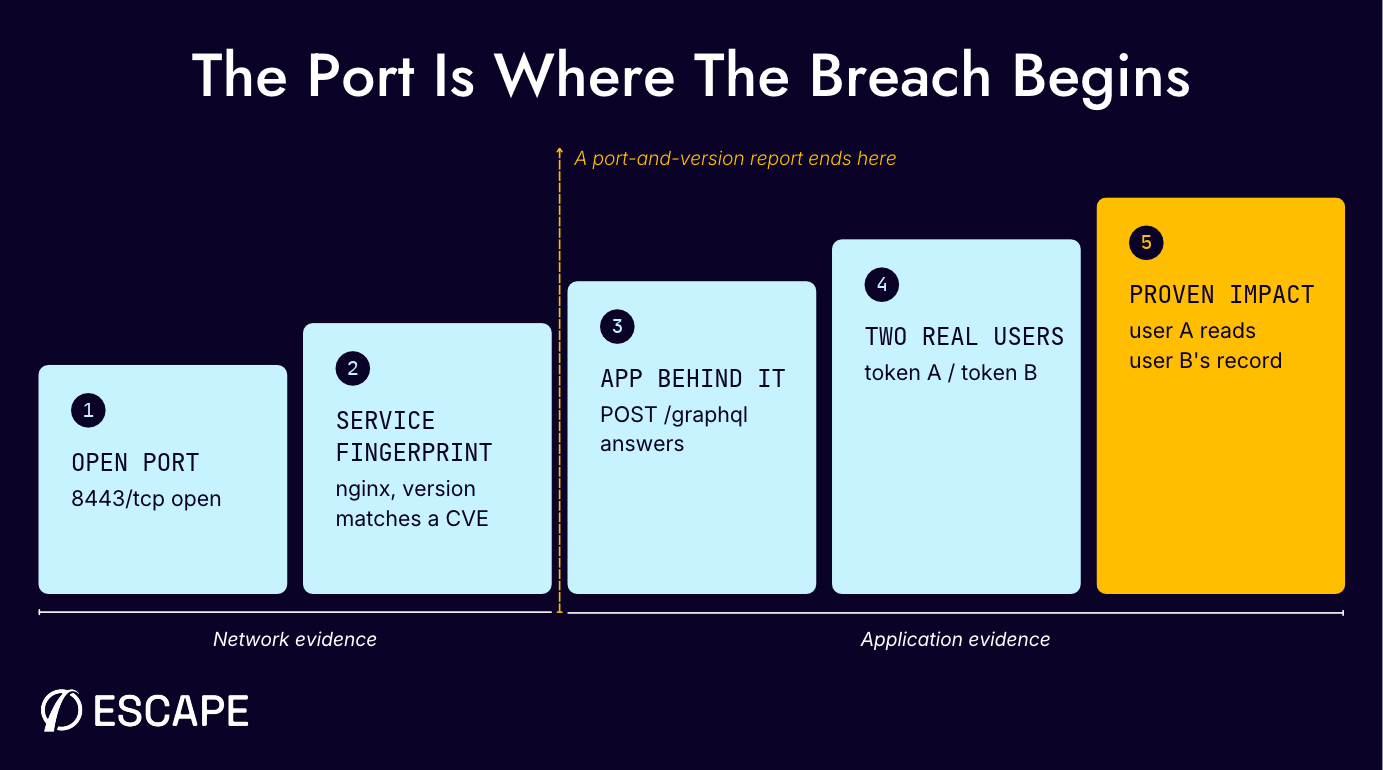
Suppose discovery finds port 8443 open, nginx responding, and a version string associated with a published CVE. That evidence identifies a service worth investigating. It does not show whether the version is reliable, whether the CVE can be used in your environment, or whether the GraphQL API behind nginx exposes data.
A NIST-aligned network penetration testing methodology follows four steps.
- Define the internal and external starting points, in-scope assets, credentials, test window, prohibited actions, stop conditions, and emergency contact.
- Run network discovery, network mapping, and port scanning, then record evidence from discovering open ports, such as port 8443, the nginx fingerprint, the observed version, and the application responding behind it.
- Validate approved attack paths against discovered vulnerabilities. For the GraphQL API, that can include checking anonymous behavior and comparing what user A and user B can access.
- Report the affected asset, request sequence, impact, risk rating, mitigation guidance, owner, and retest result.
NIST SP 800-115 calls planning, discovery, attack, and reporting “an example of how the penetration process can be divided into phases”. Reporting runs throughout the work, so a useful evidence trail begins during discovery and continues through the engagement.
What should a network penetration test cover, from initial access to attack paths?
For the external scope, list public IP ranges, cloud accounts, load balancers, remote access services, exposed management interfaces, and any service deployed directly to an IP address.
Include the application reached through each service, since a web server can hide SQL injection or broken authorization, and web application penetration testing tools may need to continue the validation after discovery identifies a web app or API.
For the internal scope, name the starting account or device, reachable ranges, directory services, credential-handling rules, multi-factor authentication on remote access, patching concerns, and segmentation boundaries.
CISA and the NSA include poor credential hygiene, poor patch management, and a lack of network segmentation in their top ten network misconfigurations, based on red-team and blue-team assessments.
Ask the tester to examine whether the initial account exposes additional credentials. The Microsoft Digital Defense Report 2025 found that 52.2% of intrusions using valid accounts involved follow-on credential theft.
Security controls in the cloud also need explicit coverage because a permissive security group or forgotten public IP can expose a service that doesn't appear in your firewall inventory.
How should you scope a network penetration test?
Use this network pentesting checklist when you review the proposal and rules of engagement.
- List cloud accounts, public IP ranges, internal ranges, and applications in scope.
- Name the internal starting point, such as a standard employee laptop or a VPN account.
- Identify each segmentation boundary and the zones on both sides.
- Record the test window, prohibited actions, out-of-scope hosts, stop conditions, and a reachable contact.
- Choose black box, gray box, or white box access and list the credentials the tester will receive.
- Ask how an exposed service is identified as a web app, API, database, remote access service, or management interface.
- Require authenticated testing for in-scope web apps and APIs, including separate user contexts when authorization matters.
- Ask whether security teams will be told in advance, and whether monitoring should flag the malicious traffic the test generates.
- Require evidence and reproduction steps that your team can use without the tester present.
- Require each finding to include the affected asset, risk rating, owner, and mitigation guidance.
- Agree how corrected findings will be retested and how the retest result will be attached to the original report.
NIST SP 800-115 says the report should “describe identified vulnerabilities, present a risk rating, and give guidance on how to mitigate the discovered weaknesses”. PCI DSS Requirement 11.4.4 also requires that “penetration testing is repeated to verify the corrections”.
How often should you run network penetration testing?
Your required date usually comes from a framework or customer commitment. Regular testing matters because cyber threats and your network both change, and significant infrastructure changes, new exposure, and corrected findings can create reasons to test sooner.
Which frameworks require a network penetration test?
PCI DSS and the NYDFS cybersecurity regulation set dated requirements for testing from inside and outside network boundaries. A separate guide to compliance penetration testing requirements provides more clause-level context.
If PCI DSS or NYDFS applies to you, plan for an annual internal and external test. PCI DSS also requires testing after significant change. Keep the HIPAA row marked as proposed until a final rule is published.
SOC 2 CC4.1 names penetration testing as one evaluation available to management, but it does not set a pentest frequency. If a customer asks for a SOC 2 pentest, confirm whether the request comes from the trust services criteria, the auditor’s expectations, or the customer’s own contract.
When is network segmentation testing required?
PCI segmentation testing applies when you use segmentation to keep systems outside the cardholder data environment. PCI DSS 11.4.5 requires a test at least every 12 months and after changes to the segmentation controls or methods. Service providers fall under 11.4.6 and must run that test at least every six months, as well as after segmentation changes.
The standard’s guidance describes the risk as attackers “moving laterally from what an entity deemed an isolated network” into the cardholder data environment. MITRE ATT&CK describes network segmentation as a way to “restrict lateral movement by adversaries”.
Your test should attempt to cross the named boundary and record whether systems outside the cardholder data environment can reach it.
What should trigger testing between annual engagements?
NIST SP 800-115 notes that “an assessment provides a snapshot of security at a given point in time” and says organizations may choose more frequent assessments.
A new cloud range, a service deployed straight to an IP address, or a DNS record pointing at an internal host can all add potential risks the week after the annual test.
Existing vulnerabilities also stay open longer than a yearly cycle assumes. Verizon’s 2026 Data Breach Investigations Report found that only 26% of critical vulnerabilities on CISA’s Known Exploited Vulnerabilities list were fully remediated in 2025.
Add a penetration test after the significant infrastructure or application changes named by PCI DSS. Between engagements, keep asset discovery scheduled and retest corrected findings.
That operating model also supports continuous offensive security testing without pretending that one annual report describes your network’s security posture today.
Manual vs automated network penetration testing
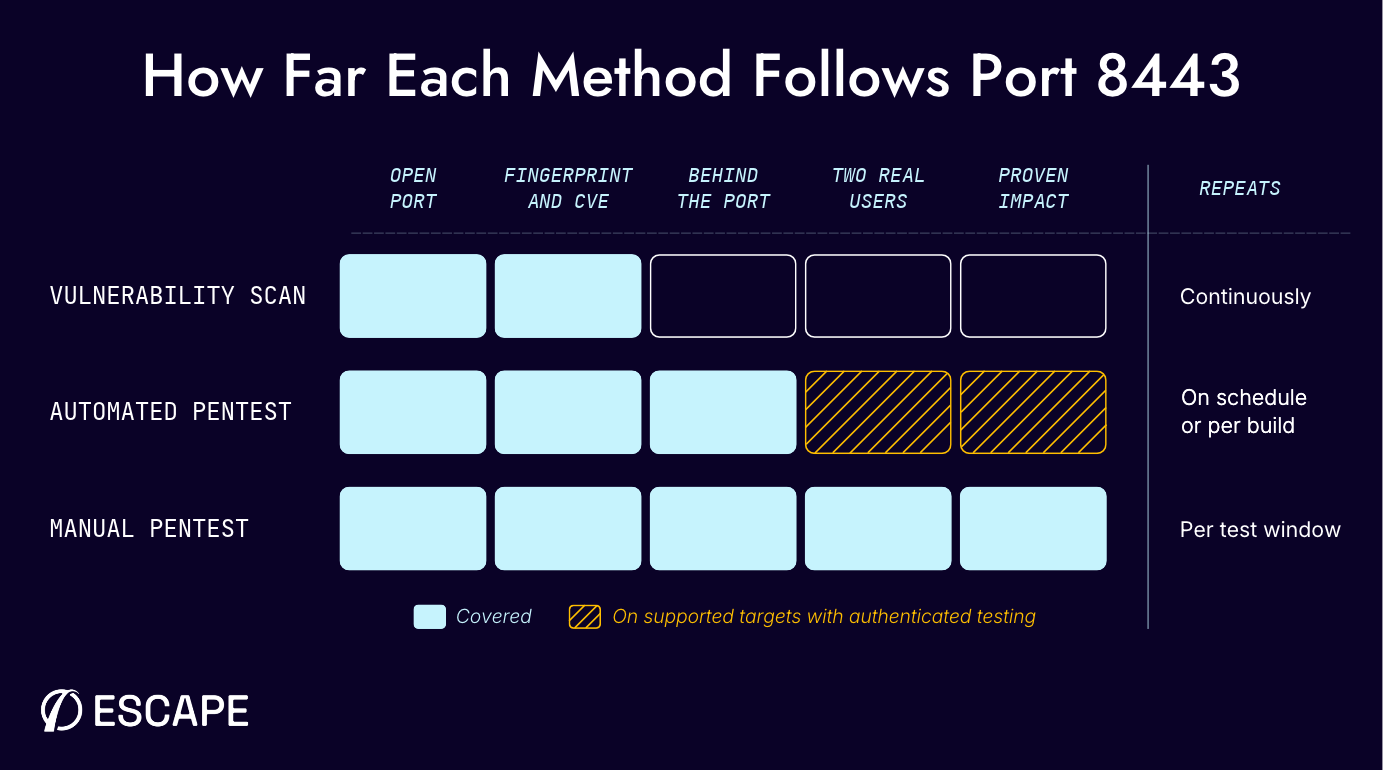
Vulnerability scans, automated tools, and manual engagements by pen testers produce different kinds of evidence for finding vulnerabilities. Compare them by what they validate, which targets they cover, how often you can repeat them, and what drives the cost.
Vulnerability scan vs automated pentest vs manual in-depth testing
Automated penetration testing repeats defined checks across a large scope and keeps evidence from each run. Penetration testers bring advanced tools and manual techniques, and adapt when the evidence points to an unfamiliar chain, a business-specific trust boundary or an internal identity path, always inside the agreed safety constraints.
The port 8443 example shows how the outputs differ. A vulnerability scan can flag the nginx version and associated CVE. An automated test may confirm a supported condition or pass the discovered GraphQL API into authenticated application testing to uncover vulnerabilities the scan cannot see.
Whichever method you buy, the report should keep both layers connected. The infrastructure owner gets the evidence for port 8443 and the service fingerprint, and the application owner gets the GraphQL request sequence showing that user A could read user B’s record, so both tickets trace back to the same tested path and the security flaws get fixed before they become a data breach.
Where Escape fits
Escape’s attack surface management rebuilds an internet-facing footprint from cloud accounts, DNS, and IP ranges. It scans 3,846 TCP ports on every discovered host, and CIDR scanning can find a service deployed directly to an IP address. It also surfaces unintentionally exposed services, such as an open FTP port, and dangling DNS records open to a subdomain takeover. That discovery feeds the pentest, and you can scan private ranges through a Private Location that you deploy.
Escape lowers the severity of a CVE match when it cannot confirm the version, and reports default credentials only after a login succeeds. Open ports feed service discovery, so a GraphQL API behind port 8443 can go straight to multi-user DAST or to Cascade, Escape’s AI pentesting engine. Cascade tests that API as several users at once and compares their contexts for broken object-level authorization, holding each identity in its own authenticated session and pulling each user's credentials from your secrets vault every time a test runs.
Cascade also reports cryptography and transport flaws and any sensitive data such as PII it can reach, each with the request and response that prove it. Where a scanner stops at a single flagged port, Cascade links the findings it validates into an attack path, which is the difference between a scan and a pentest.
Issue Retest re-runs only the tests behind the DAST and AI pentesting findings you select, and returns one of four verdicts, including Verified fixed and Vulnerable. If your auditor expects results from a qualified tester, Escape’s OSCP-certified staff can review and certify the pentest results, so you don’t need a second firm. Keep Active Directory, lateral movement, and network segmentation testing in a separate human-led internal engagement.
Conclusion
Judge network penetration testing services by whether they follow each important port to the service and application behind it, and whether every fix can be retested, since that is what improves your organization’s security posture. Keep identity paths, lateral movement, and segmentation in a human-led internal scope. To see how Escape connects external discovery and service fingerprinting to authenticated testing for the web apps and APIs it finds, book a demo.
FAQs
What are the main types of network penetration testing?
External and internal testing describe where the tester starts. An external test begins on the internet. An internal test begins from an assumed foothold such as an employee device or VPN account, and segmentation testing attempts to cross a specific boundary between network zones.
What are the stages of a network penetration test?
NIST SP 800-115 uses four phases: planning, discovery, attack, and reporting. Reporting occurs throughout the other phases so the tester preserves evidence as the work proceeds. Your final workflow should also include remediation and a retest, even though NIST’s four-phase model places them outside the named sequence.
How often should you run a network penetration test?
PCI DSS and NYDFS require testing at least annually, and PCI DSS also calls for testing after significant change. PCI service providers that use segmentation must test those controls at least every six months. Add testing sooner when a major network change or unresolved exposure makes the annual result stale.
Is a vulnerability scan the same as a network penetration test?
A vulnerability scan identifies potential weaknesses based on observed hosts, services, and versions. Pen testing attempts to validate selected vulnerabilities and records the access or impact it produces. You need recurring scanning for coverage and penetration testing for evidence of exploitability.
Is pentesting being replaced by AI?
AI can repeat defined application-layer checks and preserve evidence across runs. Humans still need to scope, handle unfamiliar attack chains, work with internal identity, and test lateral movement and segmentation. Your scope should state which security assessments are automated and which require a tester, so your security posture reflects both.
How much do network penetration testing services cost?
The quote usually reflects the number of IPs and hosts, internal and external starting points, segmentation boundaries, credentials, test windows, reporting requirements, and retest work. Ask the provider to separate those drivers in the proposal so you can compare equivalent scopes. Do not compare two quotes until their exclusions and retest terms match.
Is network penetration testing legal?
Treat the work as authorized only when the asset owner has approved it in writing. The authorization should name the assets, dates, allowed actions, prohibited techniques, stop conditions, and responsible contacts. Get legal advice for jurisdiction-specific questions or any system whose ownership is unclear.
Sources
- NIST SP 800-115, Technical Guide to Information Security Testing and Assessment - NIST
- Penetration testing, glossary definition - NIST Computer Security Resource Center
- PCI DSS v4.0.1, Requirement 11.4 - PCI Security Standards Council
- 23 NYCRR 500.5, Vulnerability management - New York Department of Financial Services, via Cornell LII
- Regulation (EU) 2022/2554, Digital Operational Resilience Act - EUR-Lex
- HIPAA Security Rule to Strengthen the Cybersecurity of Electronic Protected Health Information, proposed rule - Federal Register
- 2026 Data Breach Investigations Report, executive summary - Verizon
- Microsoft Digital Defense Report 2025 - Microsoft
- Network Segmentation, M1030 - MITRE ATT&CK
- Top Ten Cybersecurity Misconfigurations, AA23-278A - CISA and NSA