Best enterprise security testing tools for continuous scanning in 2026

Your DAST contract is up for renewal, the yearly pentest is booked for the same month, and your few hundred web apps and APIs have outgrown both, so it’s time to compare enterprise security testing tools for continuous scanning. Mandiant’s M-Trends 2026 puts the mean time to exploit at minus seven days, so attackers routinely get in before a patch exists. In this article you’ll learn how to match each testing type to the trigger that keeps coverage continuous, judge tools on the criteria that hold up at enterprise scale, and leave with a clear pick for each job.
TL;DR
- Match each test to a trigger. Run DAST on every deploy, AI or autonomous pentesting on change or on a schedule, and asset discovery so both stay pointed at what is actually exposed.
- Shortlist on six things that scale. Asset coverage, scan frequency, CI/CD triggers, false-positive handling, SSO and RBAC, and compliance reporting tell you more than any detection claim.
- Continuous coverage pays off when you ship often. If you release weekly, a platform that tests every deploy catches issues a once-a-year pentest window never sees. Keep an independent pentest where a standard or customer requires one.
What are enterprise security testing tools?
Enterprise security testing tools look for exploitable weaknesses across your applications, APIs and infrastructure, and some confirm what they find. Continuous security testing just means each test fires on a trigger, such as a merge, a deploy, a schedule or a newly discovered asset, so testing keeps pace with your releases.
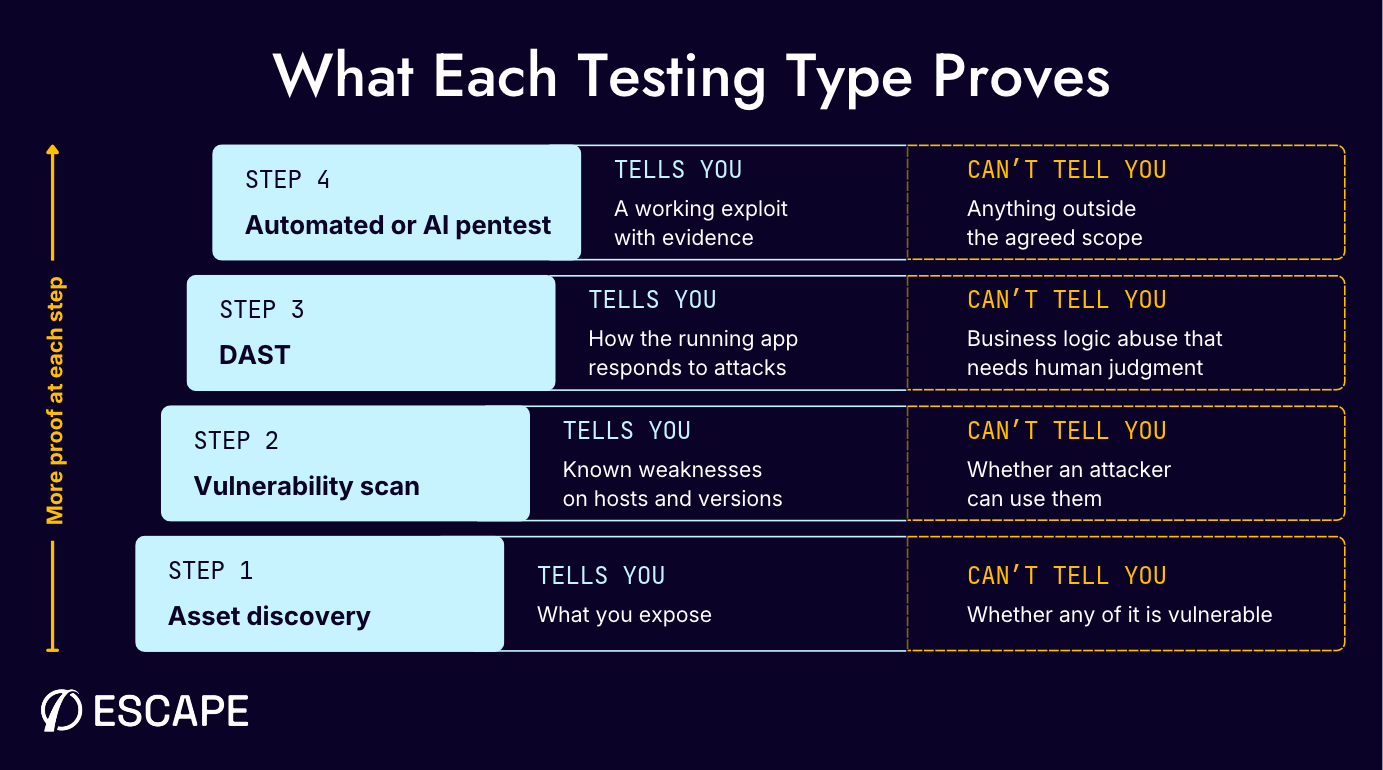
The category covers four testing types, which are attack surface discovery, vulnerability scanning, dynamic application security testing (DAST) and automated or AI penetration testing. The PCI Security Standards Council’s ASV resource guide draws the line between scanning and pentesting, since a vulnerability scan identifies known weaknesses without exploiting them and a penetration test tries to exploit them to gain access.
Automated tools are good at breadth and repetition, but the OWASP Web Security Testing Guide points out that they don’t understand business logic or context. Enterprise programs add pentest-style testing on top of their continuous scanning tools to cover that gap.
How to choose an enterprise security testing tool
What separates these tools is what each one can see, what starts a test and how it fits your identity and audit setup. Start with the trigger, since it rules tools in or out fastest.
What continuous vulnerability scanning looks like at enterprise scale
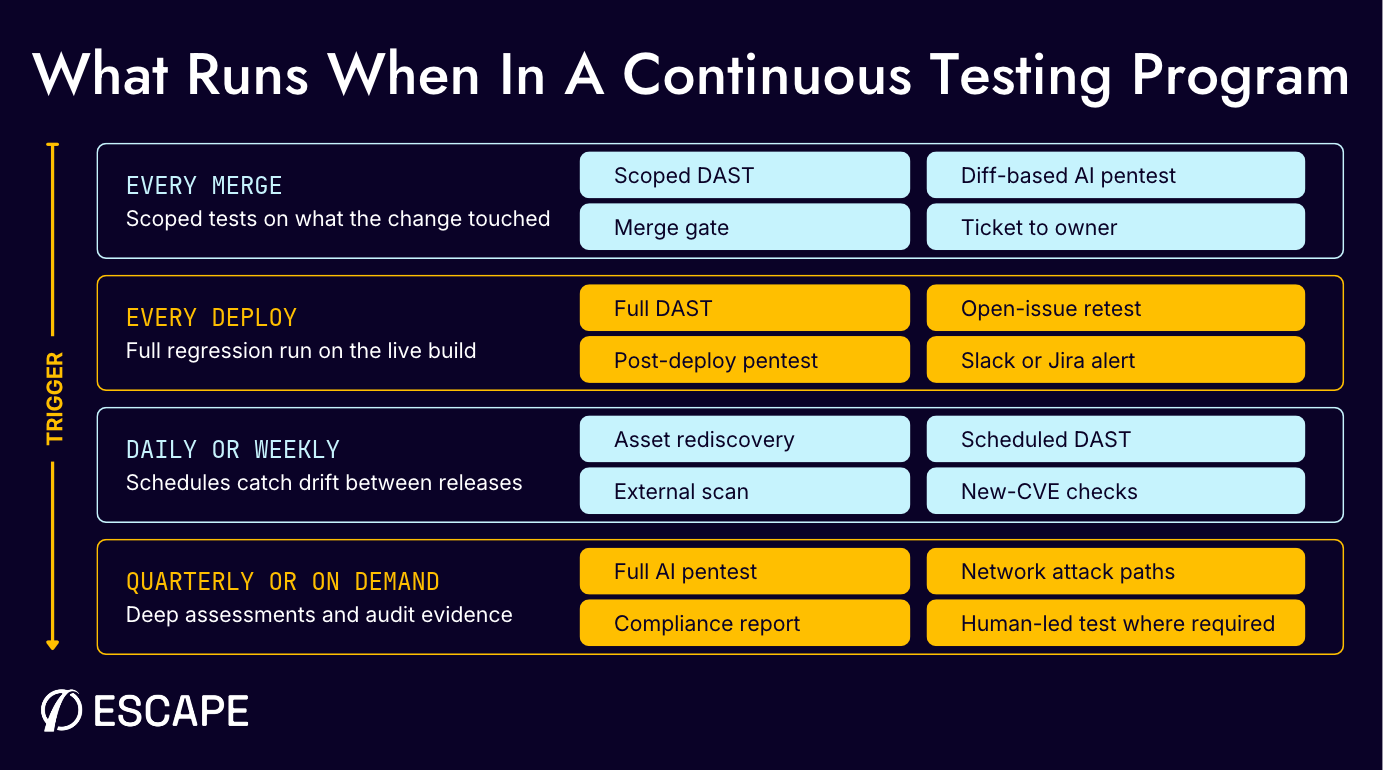
At enterprise scale, continuous vulnerability scanning means running each type of test when something changes, whether that’s a merge or a host that just appeared on the internet. The UK’s NCSC advises running application scanners whenever the application changes and scanning infrastructure at least once a month.
PCI DSS sets the floor at quarterly internal and external scans, plus a scan after any significant change, according to the Requirement 11 text that Microsoft Learn reproduces. The PCI Security Standards Council’s own ASV resource guide goes further and recommends scanning more often than that.
Under CISA’s BOD 26-04, federal agencies will have as little as three days to fix the highest-risk exploited, internet-exposed vulnerabilities once the directive’s remediation timelines start on December 7 2026, which a quarterly scan can’t hope to meet. Triggers are also where the nine tools differ most, so every table gives them their own row.
Asset coverage and scan frequency
Coverage starts with an inventory, since a scanner only tests the targets you give it, and attack surface discovery automates that.
Depth varies by layer, so check whether a tool finds APIs, single-page apps and undocumented endpoints, and which of REST, GraphQL, SOAP and gRPC it supports. Scan frequency often tracks the plan, with scheduled or daily scans on higher tiers, and internal apps need a private scanning location or agent to reach them.
Coverage also stops at the login page, and the NCSC warns that a scanner without login support won’t cover complex web apps well. Check whether a tool holds a session through OAuth, MFA or CAPTCHA and can test as several users at once, since broken object level authorization tops the OWASP API Security Top 10 and a single-account scan has no second account to compare against.
CI/CD triggers and false-positive rate
The CI/CD trigger decides whether you test every release or only some of them, so check which CI systems a tool supports and whether a scan can block a merge. A tool runs either from a native pipeline step, from an API call your pipeline makes, or only on schedules and on demand with no documented pipeline trigger.
Noisy findings get ignored, and the NCSC lists accuracy, false positives and false negatives among the core questions to ask a scanner.
Vendors cut that noise in different ways, and only some confirm the issue itself. Proof-based checks and agents that reproduce each exploit prove a finding, request and response evidence shows what confirmed it, and plain de-duplication only trims the list.
SSO, RBAC and compliance reporting
SSO for the tool’s own console starts to matter once dozens of teams log in, so check for SAML or OIDC support and which plan includes it. RBAC should scope access by team or project, letting each business unit see only its own assets and findings.
Audit logs and user lifecycle belong in the same review, including whether SCIM removes leavers automatically or someone does it by hand. Compliance reporting runs from findings mapped to PCI DSS, SOC 2, ISO 27001 and HIPAA down to a plain pentest report. PortSwigger and Pentera both state that their reports don’t certify compliance.
PCI DSS still requires a quarterly external scan by an Approved Scanning Vendor, according to the PCI Security Standards Council’s ASV resource guide. A continuous tool gives you evidence between those scans, and the ASV scan stays on your calendar.
Enterprise security testing tools compared
How much ground these tools cover varies widely, so the first thing to pin down is what each one actually reaches. Some only run DAST, some only pentest, and a few combine scanning, DAST, and pentesting in one platform, which is what the table maps out tool by tool.
DAST checks how a running app responds to attacks, while automated and AI pentesting go further and try to exploit what they find, chaining it into attack paths across networks and identity. If you are still choosing a testing type, Escape’s guide explains how DAST compares with SAST and IAST.
Partial means the capability is an add-on, in beta or narrower than a full module, and the note in the cell says which.
Escape
Escape is an offensive security platform that runs AI pentesting continuously across web apps, APIs, AI agents, mobile apps and your internal and external network, all from one platform, with network testing in beta. It runs a baseline pentest on each application, then retests on every merge, deploy or scheduled cycle, alongside business-logic-aware DAST in CI.
Its agents start from what has already gone wrong in your apps. Escape ingests your past bug bounty findings and pentest reports and turns them into attack scenarios, so if earlier reports kept finding XSS, every run tests for it. The agents then chain requests across authentication, authorization and business logic to find IDORs, broken access control and SSRF, and each finding comes with proof of exploitability and a suggested fix.
Every run keeps a full audit trail of what was tested. When an audit calls for human sign-off, OSCP-certified pentesters review and certify the report, so continuous testing and certified pentest evidence come from the same place.
“It gives a good remediation process and steps to reproduce, which makes our team 10 times more efficient for validating vulnerabilities.” - Andrew Orr Erwing, Security Engineering Manager, Applied Systems
Escape is built for large organizations with lean security teams that need pentest coverage across the whole portfolio without adding headcount. It doesn’t test Active Directory or sell a standalone SAST or SCA product. Escape’s guide to continuous penetration testing tools compares the options in depth.
Escape’s guide to continuous penetration testing tools compares the options in depth.
| Criterion | Escape |
|---|---|
| Testing type | Continuous AI pentesting, plus business-logic-aware DAST, attack surface management and AI network pentesting (beta) |
| Asset coverage | Web apps, REST and GraphQL APIs, AI agents, chatbots and MCP servers, with discovery of APIs, SPAs, gRPC and SOAP services |
| Login and MFA handling | OAuth, TOTP MFA and AI-powered text CAPTCHA solving, multi-user testing across roles |
| Scan frequency and triggers | Baseline pentest per app, then continuous runs on merge (GitHub App), after a deploy (CI or API call) or on a daily, weekly or monthly schedule. DAST runs in CI. |
| False-positive handling | Proof of exploitability on each finding, every open issue replayed on each run, known issues kept as one issue instead of re-ticketed |
| SSO and RBAC | SAML 2.0 and OIDC SSO, project-based RBAC, audit logs |
| Compliance reporting | Findings mapped to 20+ standards and frameworks, including PCI DSS, SOC 2, ISO 27001, HIPAA and DORA, reasoning logs for every run, OSCP-certified report on request |
| Pricing | Quote |
| Best for | Large organizations with lean security teams that need pentest coverage across the whole portfolio, on every release |
Intruder
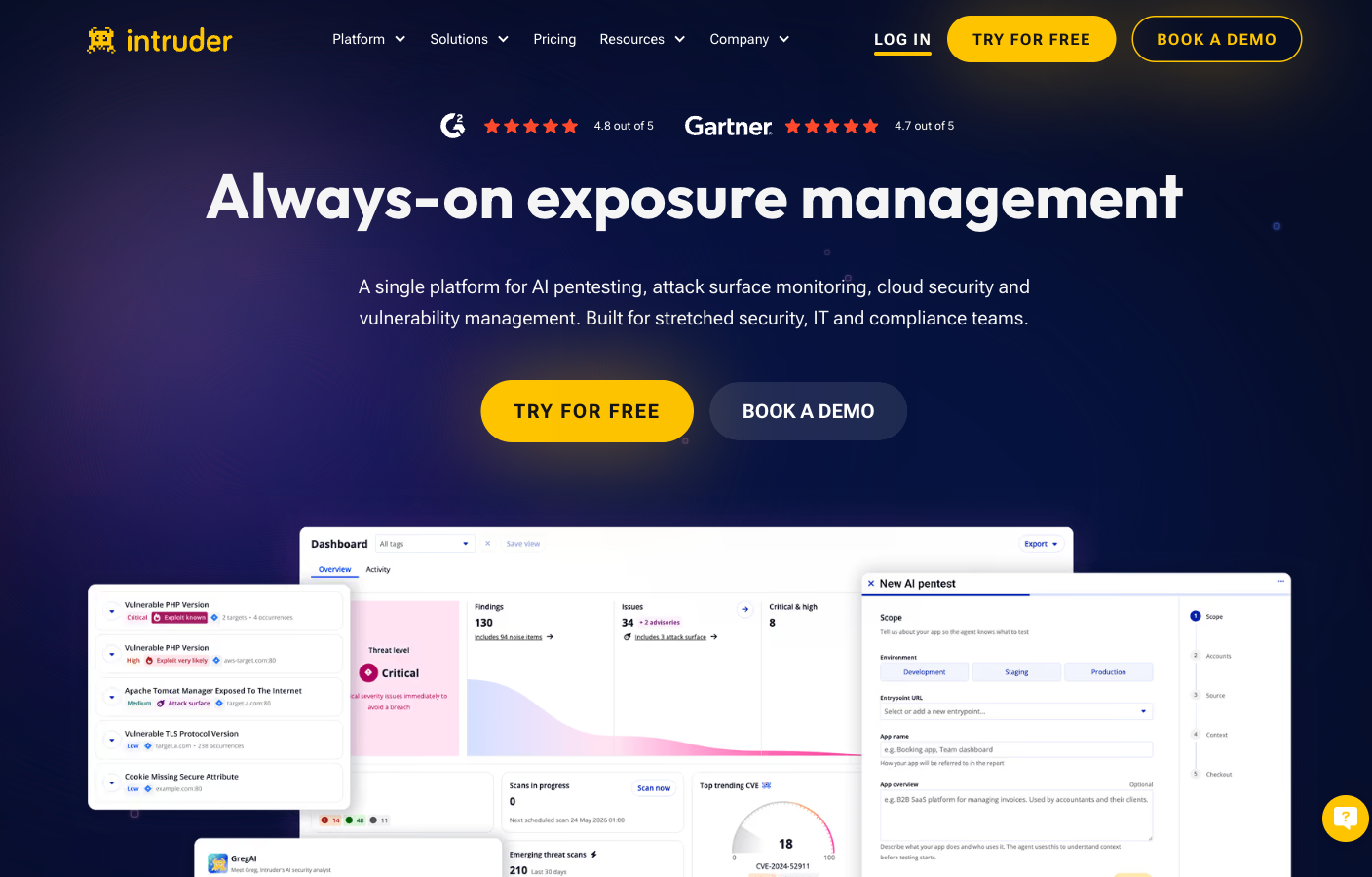
Intruder puts vulnerability scanning, DAST, attack surface monitoring, cloud security and AI pentesting in a single platform, so it spans infrastructure and applications from one console. On top of scheduled scans, it runs emerging-threat scans within hours of a critical vulnerability going public.
Aikido Security
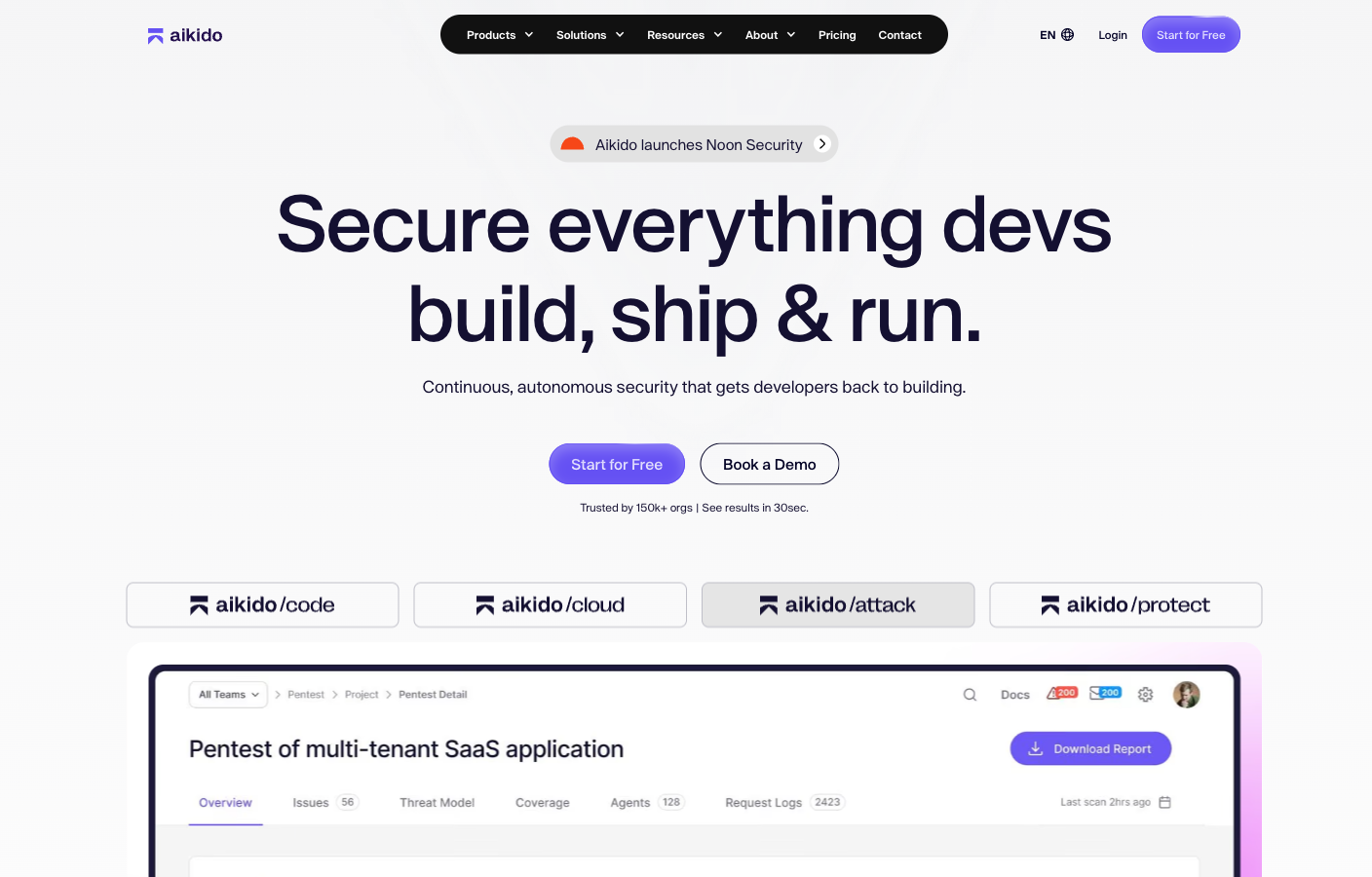
Aikido bundles SAST, SCA, cloud and container scanning with DAST, attack surface monitoring and a separately priced AI pentest in one software security platform, so it reaches from code to a running app. Its DAST runs a subset of ZAP scans against live apps.
You’ll need an OpenAPI spec or Aikido’s Zen agent to feed it API endpoints, since the scanner doesn’t discover them from the frontend. Internal network and Active Directory testing aren’t described.
Invicti
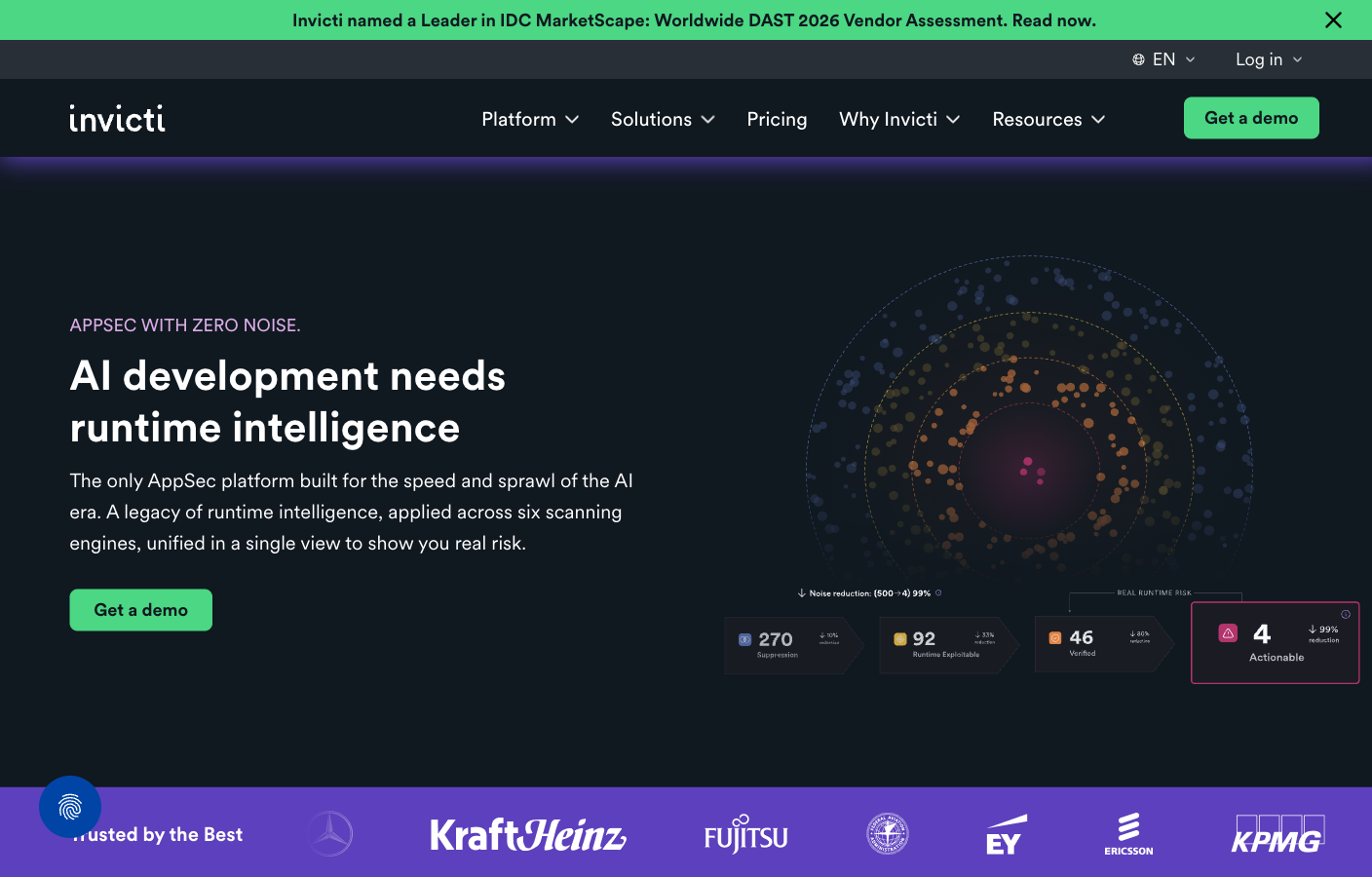
Invicti is a DAST-led AppSec platform for web apps and APIs, and you can feed it OpenAPI, Postman, WSDL and GraphQL definitions. Proof-Based Scanning confirms a finding by safely exploiting it in a read-only way, which means your team can auto-ticket only confirmed issues.
It deploys as SaaS, on-prem or hybrid.
Its DAST stops at web apps and APIs, code scanning comes as separate SAST and SCA modules, and a separately priced Agentic Pentest add-on handles automated pentesting.
| Criterion | Invicti |
|---|---|
| Testing type | DAST, Agentic Pentest (add-on) |
| Asset coverage | Web apps and APIs |
| Login and MFA handling | Form, OAuth2 and recorded login sequences with OTP, multi-session scanning for access control, logins with a manual step limited to instant scans |
| Scan frequency and triggers | Schedules, or CI with Azure Pipelines, CircleCI, GitHub Actions, GitLab and Jenkins |
| False-positive handling | Proof-Based Scanning with a read-only exploit |
| SSO and RBAC | SAML 2.0 SSO, SCIM, RBAC |
| Compliance reporting | HIPAA, ISO 27001, NIST 800-53, OWASP Top 10, ASVS, PCI DSS |
| Pricing | DAST on quote, Agentic Pentest “$500 max per pentest” |
| Best for | Confirmed DAST findings auto-ticketed from CI |
Burp Suite
Burp Suite is a DAST tool at enterprise scale. Burp Suite Professional is PortSwigger’s manual web testing toolkit, and Burp Suite DAST takes the same scanning engine across your whole portfolio on schedules and in CI. You can deploy it as managed cloud, self-hosted, on Kubernetes or air-gapped.
PortSwigger added agentic testing in July 2026 with Burp AT, launched in public beta for Burp Suite Professional users, and announced Burp AT for enterprises in November 2026. Agents take on defined testing tasks inside Burp while a human tester keeps control of scope and conclusions, so it extends human-led pentesting rather than running on its own.
Discovery works at crawl level, so it finds the endpoints of each app it scans. PortSwigger states its compliance reports don’t guarantee compliance.
| Criterion | Burp Suite |
|---|---|
| Testing type | DAST (Burp Suite DAST), manual toolkit (Professional), agentic testing (Burp AT) |
| Asset coverage | Web apps across a portfolio, with crawl-level endpoint discovery |
| Login and MFA handling | Recorded logins with TOTP steps detected, OAuth 2.0 client credentials for APIs |
| Scan frequency and triggers | Schedules, or a pipeline step in Jenkins, GitHub Actions, GitLab CI, Azure DevOps, Bitbucket Pipelines, CircleCI and TeamCity |
| False-positive handling | Request and response evidence on every finding |
| SSO and RBAC | SAML SSO, LDAP, RBAC |
| Compliance reporting | OWASP Top 10 2025, PCI DSS v4.0.1 |
| Pricing | Professional $499 a year per user, DAST custom |
| Best for | Portfolio-wide DAST and human-led testing for teams already on Burp |
StackHawk
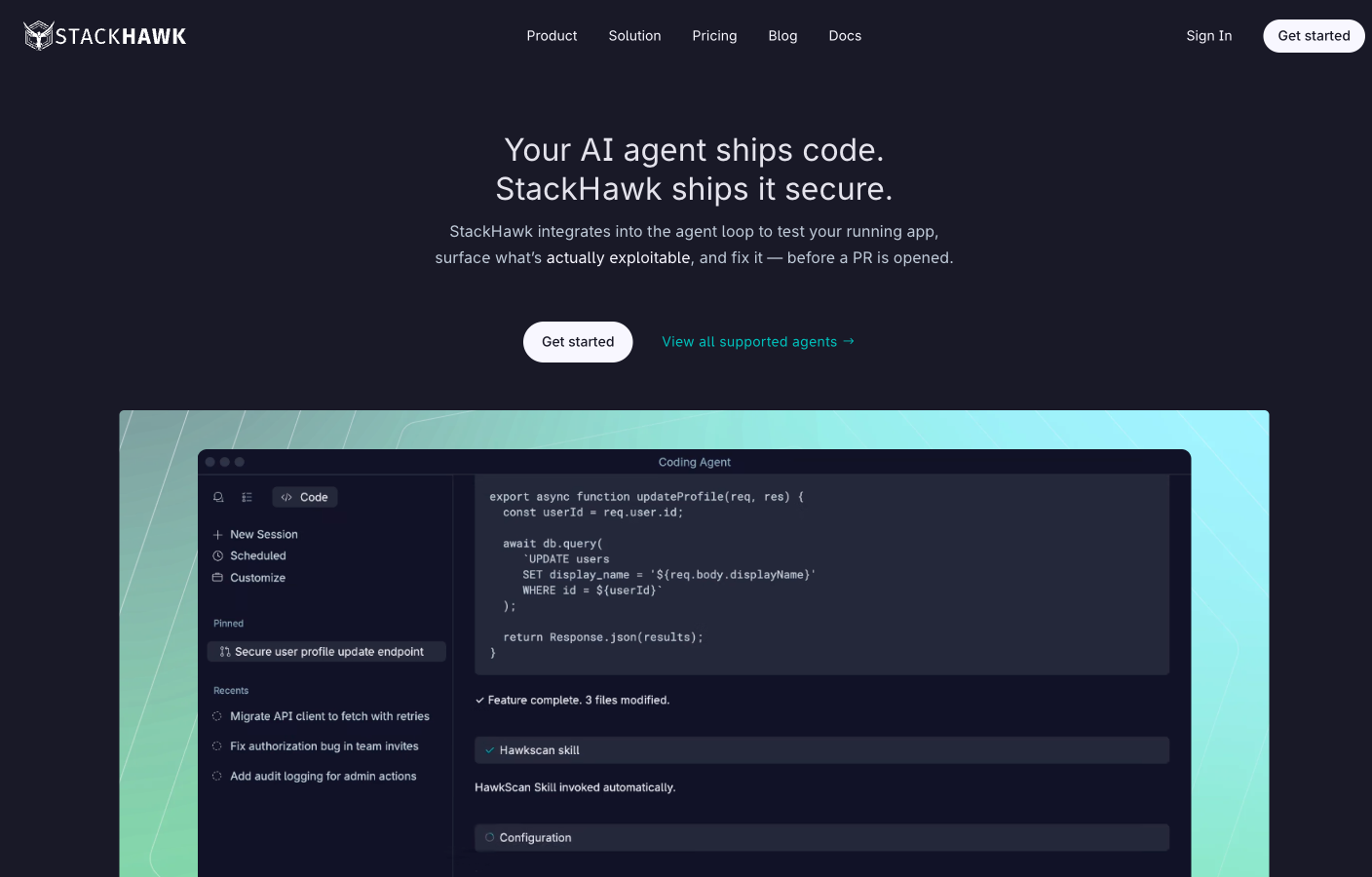
StackHawk is a DAST tool built for developers who want it inside CI/CD and, as of 2026, inside AI coding-agent loops too. Its CI docs name the broadest list in this set, and HawkScan has shipped as a native binary since version 6.0.0.
There’s no documented built-in scheduler, so you’d schedule scans with cron or your pipeline’s scheduler.
API discovery from code repositories sits on the Scale plan.
| Criterion | StackHawk |
|---|---|
| Testing type | DAST |
| Asset coverage | REST, GraphQL, SOAP and gRPC APIs, LLM interfaces, MCP servers |
| Login and MFA handling | Form, OAuth and custom authentication scripts, multi-user business logic testing, MFA not stated |
| Scan frequency and triggers | Pipeline step in GitHub Actions, GitLab CI/CD, Jenkins, Azure Pipelines, CircleCI, Buildkite, Harness and others, or cron |
| False-positive handling | Runtime testing claimed to reduce false positives, no separate proof step documented |
| SSO and RBAC | SAML SSO and roles on Scale |
| Compliance reporting | Report docs describe no framework mapping |
| Pricing | Wingman “$10/user/mo.”, Scale on quote |
| Best for | Developer-run DAST inside CI/CD and coding-agent loops |
Pentera
Pentera is an automated pentesting platform for networks and web apps. Its Core, Surface and Cloud modules test internal networks, the external perimeter and cloud identity, and Core also covers Active Directory. For enterprise penetration testing of infrastructure, you can run it in live production, and a separate solution page adds AI testing of web apps and APIs behind SSO, MFA and OAuth.
Findings are chained into attack paths, and fixes get re-tested so you have proof of resolution. Pentera says its web app testing runs continuously, on every release, and its API can start a scan as a step in your CI/CD pipeline.
| Criterion | Pentera |
|---|---|
| Testing type | Automated pentesting (security validation) |
| Asset coverage | Internal network, external perimeter, cloud identity, Active Directory, web apps and APIs |
| Login and MFA handling | Credentials, tokens or session details for testing behind SSO, MFA and OAuth (web app solution) |
| Scan frequency and triggers | On demand, schedule, AI prompt or an API call from a CI/CD step |
| False-positive handling | Findings proven and chained into attack paths, fixes re-tested |
| SSO and RBAC | Not stated |
| Compliance reporting | Maps findings to PCI DSS, SOC 2, ISO 27001, NIST, DORA, HIPAA (states it doesn’t certify compliance) |
| Pricing | Quote |
| Best for | Validating network, perimeter and Active Directory attack paths |
Horizon3.ai NodeZero
NodeZero is Horizon3.ai’s autonomous pentesting platform for networks and web apps, with an Active Directory password audit and a separately priced WebApp product. Internal tests run from a Docker host or OVA with no agents, and external tests run from Horizon3.ai’s cloud.
“1-click verify” re-tests a fix and gives you a report for auditors, and Horizon3.ai also sells a compliance pentesting service, run by OSCP pentesters with NodeZero, for PCI DSS, SOC, DORA and CMMC requirements. Its CLI and API can launch pentests from a CI/CD pipeline.
| Criterion | Horizon3.ai NodeZero |
|---|---|
| Testing type | Autonomous pentesting |
| Asset coverage | Internal, external, AWS, Azure, Kubernetes, AD password audit, WebApp |
| Login and MFA handling | Network tests with or without credentials, WebApp logins with TOTP MFA and backup codes, SSO through Entra, Okta, Auth0, PingID and Keycloak |
| Scan frequency and triggers | On demand, recurring schedules on Core, Pro and Elite, or CLI and API calls from a CI/CD pipeline |
| False-positive handling | Proof of exploit, 1-click verify re-test |
| SSO and RBAC | OIDC SSO, three roles |
| Compliance reporting | 1-click verify report for auditors, separate OSCP-led compliance pentesting service |
| Pricing | $15 per asset per test (Flex), $50 to $85 per asset per year (Core, Pro, Elite), WebApp Flex $10,000 per app per test |
| Best for | Autonomous network and identity pentesting with audit-ready proof |
XBOW
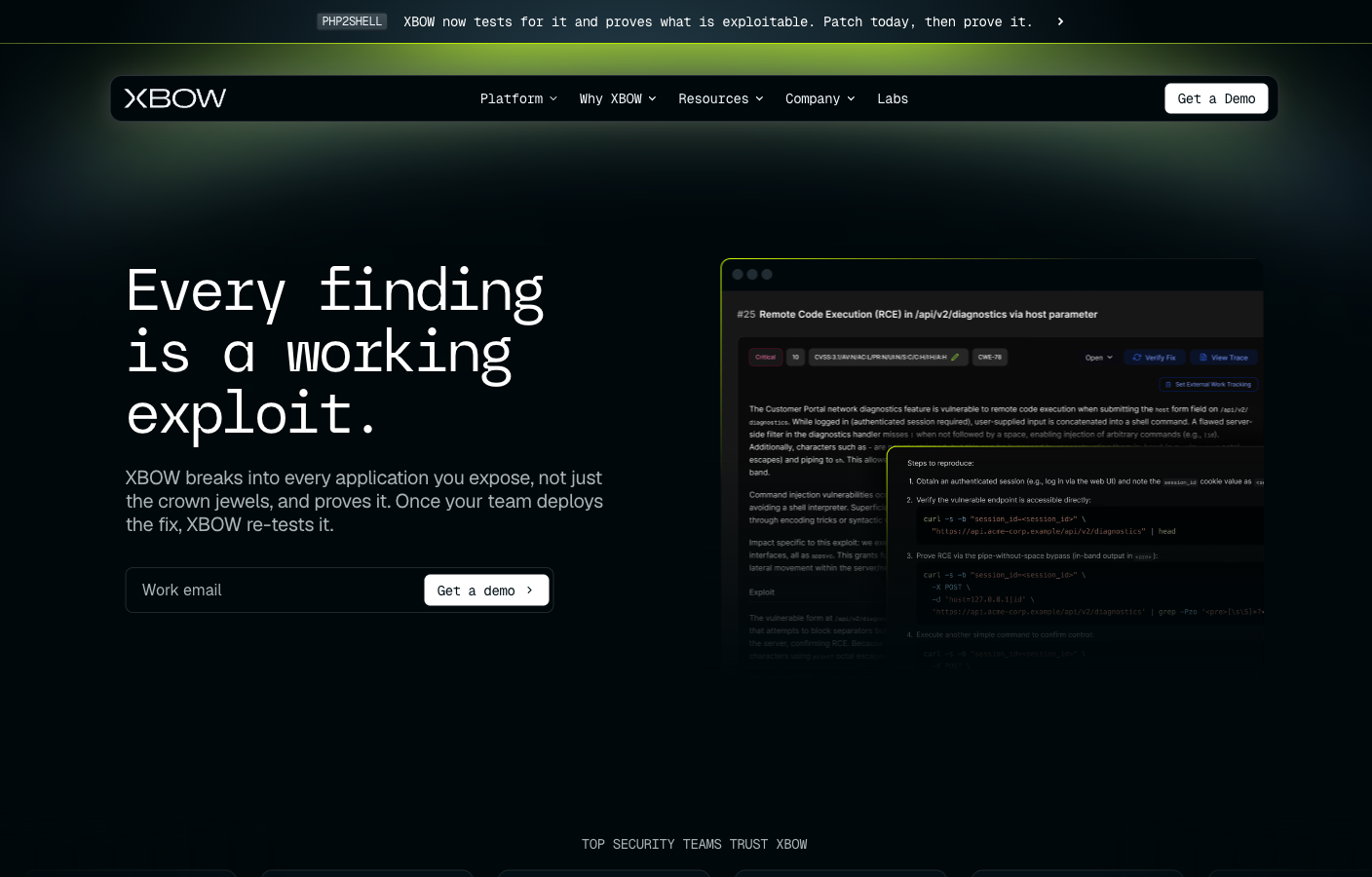
XBOW is an AI pentesting tool that pentests web applications and their APIs autonomously, and its docs say other asset types are on the roadmap. You kick off per-asset pentests from your own scheduler or CI through the API.
Its console offers data residency in five regions, in private preview.
It sticks to web apps and APIs, with no network, cloud or Active Directory testing. Escape’s roundup of AI pentesting tools goes deeper on that category.
| Criterion | XBOW |
|---|---|
| Testing type | AI pentesting |
| Asset coverage | Web apps and their APIs |
| Login and MFA handling | Username and password, TOTP MFA, SSO and magic links, extra accounts for IDOR analysis (preview), CAPTCHA not supported |
| Scan frequency and triggers | API call from your scheduler or CI, on merge or pre-deploy |
| False-positive handling | Non-AI validators verify each exploit on every applicable finding |
| SSO and RBAC | SAML 2.0 or OIDC SSO (public preview), six roles |
| Compliance reporting | Attestation letter for auditors |
| Pricing | Usage-based, on quote (launch pricing started at $4,000 per test) |
| Best for | Autonomous web app and API pentesting triggered from CI |
Continuous testing vs a yearly pentest retainer
The clearest way to compare the two models is to picture the same app going through both for a year.
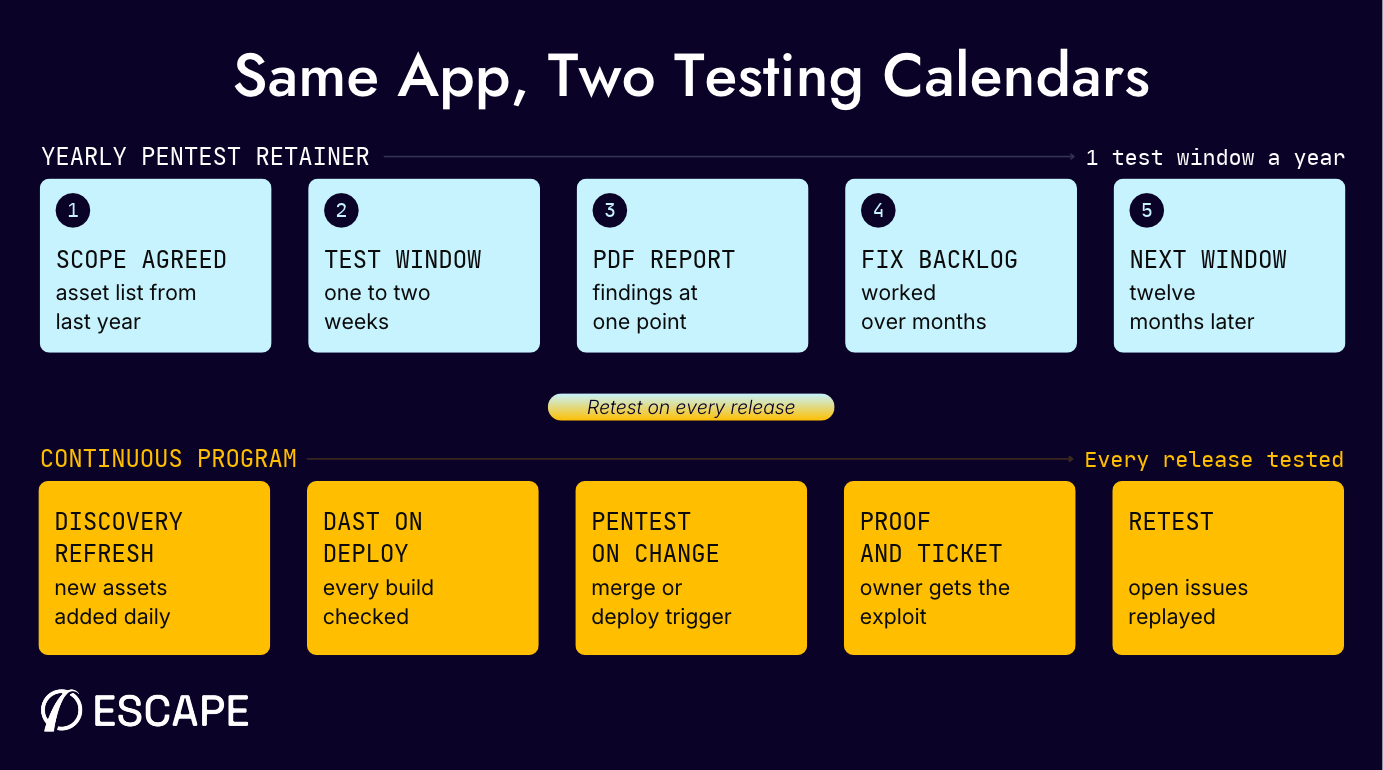
What changes in cost and coverage
A yearly retainer buys one test window against the scope agreed at kickoff, while a continuous platform is priced per app, asset or month and re-tests every release. The return grows with how often you ship, since every deploy between yearly windows carries untested code and a later build can quietly undo a fix.
The best ROI against a yearly retainer comes from platforms that test each release without a new engagement, and Escape starts an AI pentest on every merge or deploy and reruns proven findings as tests on every build. Escape runs a baseline pentest per app, retests on every merge, deploy or schedule, and replays every open issue on each run, so a fix only closes once it’s verified.
Published prices are only rough anchors and rarely compare like for like, with Horizon3.ai WebApp Flex at $10,000 per app per test, Intruder AI web app pentests from $3,500 and Invicti’s Agentic Pentest at a $500 maximum, so match quotes to the same scope. Escape’s guide to automated penetration testing tools breaks down manual and automated testing costs line by line.
When a human-led pentest is still required
Some standards and customers still require a test by a qualified, independent tester, so a common pattern is one human-led engagement a year alongside continuous testing. PCI DSS asks for internal and external pentests at least every 12 months and after significant changes, plus quarterly external scans by an Approved Scanning Vendor, per the Requirement 11 text on Microsoft Learn.
The NCSC says automated scanning can’t match manual testing for breadth and depth, but AI pentesting now covers much of that depth between engagements, so the human-led test checks a program that’s already running.
Some platforms now bundle the human step. Escape offers OSCP-certified pentester review and sign-off on its AI pentest reports, and Horizon3.ai sells an OSCP-led compliance pentesting service. Whether that sign-off meets a given requirement is your assessor’s call, and it doesn’t replace the quarterly ASV scan.
Conclusion
Build the shortlist from your asset inventory, map each layer to a trigger, then run a two-week proof of value on the hardest authenticated app you have, and check that every fixed finding gets retested on later builds. To see Escape test that app as several users and retest each fix on every build, book a demo.
FAQs
What are the best application security testing tools for enterprises?
It depends on how much one tool needs to cover. Escape, Intruder and Aikido span several testing types on one platform; Invicti, Burp Suite and StackHawk focus on DAST, and Pentera, Horizon3.ai and XBOW focus on automated or AI pentesting. Match that to whether your risk sits in web apps and APIs or in networks and identity, and the summary table compares all nine on the same capabilities.
What is the difference between vulnerability scanning tools and DAST?
Vulnerability scanning tools check hosts, services and software versions against known vulnerabilities. DAST attacks a running web app or API from the outside to find flaws in how it behaves.
Most lists of vulnerability scanning tools rank infrastructure scanners that work at the network layer, while DAST works at the application layer. A vulnerability scan identifies weaknesses without exploiting them, as the PCI Security Standards Council defines it, and some DAST products validate selected findings, while a pentest attempts exploitation across a defined scope.
Escape’s guide to vulnerability scanning tools covers the infrastructure side.
Is penetration testing as a service the same as continuous security testing?
No, because penetration testing as a service (PTaaS) sells human-led tests through a platform, usually per engagement, while continuous security testing runs automated or AI-driven tests on triggers. A common setup uses PTaaS for the signed reports and a continuous platform in between, and Escape’s PTaaS explainer covers that delivery model in detail.
How often should enterprise applications be scanned?
The NCSC advises scanning applications whenever they change and infrastructure at least once a month, and PCI DSS sets a quarterly floor plus scans after significant change. In practice, that means DAST in CI on every deploy, with scheduled discovery and infrastructure scans in between releases.
Which security testing tools trigger a new test on every deployment?
Escape (continuous pentesting on merge or after deploy, with DAST in CI), Aikido (its continuous AI pentest tier) and XBOW (API-triggered on merge or pre-deploy) start a pentest per release. Invicti, Burp Suite DAST and StackHawk run DAST as a pipeline step, and Pentera and Horizon3.ai can be started from a pipeline through their API or CLI.
Which DAST tools are best for continuous security coverage?
Invicti, Burp Suite DAST and StackHawk run DAST as a pipeline step, so a scan fires on every deploy. Escape adds business-logic-aware DAST on the same CI triggers and tests behind OAuth, MFA and CAPTCHA, which matters when your riskiest flaws sit behind a login.
What is continuous security validation?
Continuous security validation runs attacker-style tests on a recurring basis to confirm your controls and fixes still hold. The term is mostly tied to autonomous network pentesting platforms, and for applications the same idea is a retest of open findings on every scan or release.
Do continuous security monitoring tools satisfy PCI DSS?
Continuous security monitoring tools give you evidence between required tests, and they don’t replace the quarterly external scan by an Approved Scanning Vendor or the annual penetration test. PortSwigger and Pentera both state that their compliance reports don’t certify compliance, so treat those reports as supporting evidence.