
AI pentesting
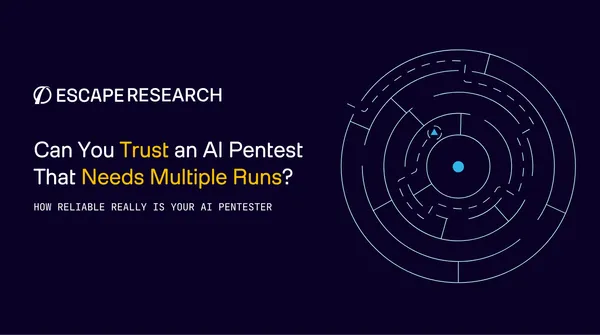
Can You Trust an AI Pentest That Needs Multiple Runs?
Why AI pentesting struggles with consistent vulnerability coverage, why repeated runs don't scale, and how Cascade makes autonomous security testing more reliable.

15 posts
AI pentesting
Why AI pentesting struggles with consistent vulnerability coverage, why repeated runs don't scale, and how Cascade makes autonomous security testing more reliable.
Product updates
How Cascade 2 Iguazu's scheduler and shared coverage map work together, how we benchmark the engine, and what two rounds of internal benchmarks reveal.


Research
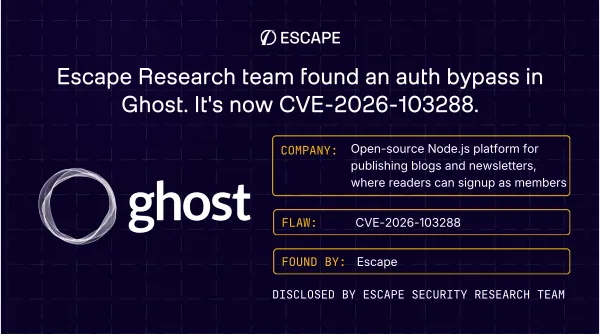
Escape's research team found two stacked flaws that led to an auth bypass enabling any member to delete all members' likes on comments. It's now CVE-2026-103288, found only by testing as multiple low-auth users to see what they could do with data they shouldn't have access to.

Research
We pointed Cascade, Escape's AI pentesting engine, at a production AI agent. The agent had a guardrail built to catch prompt injection. Cascade got past it on the second try. The trick wasn't a smarter payload, just a different pretext, and the agent handed over its entire system prompt: the tools it could call, the rules it followed, and the session details attached to the conversation. That alone gives an attacker what they need to go straight at the agent's tools instead of guessing at them
Research
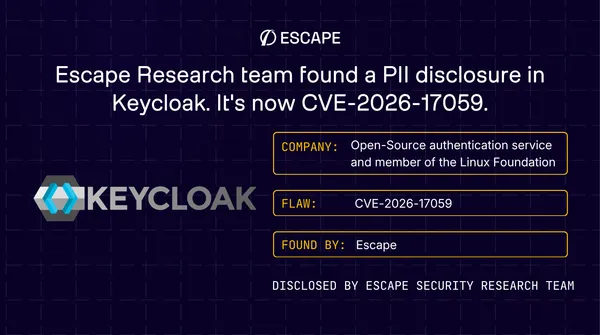
Keycloak filters its main users list so a restricted admin sees nothing. The endpoint that lists a role's members skips that filter and hands the same account everyone's email and name. Escape research found it, reported it, and it's now tracked as CVE-2026-17059.

Research
Bruce Schneier : "security is a process, not a product". It’s not enough to audit your application once, every new feature introduces new attack surfaces that must be taken into account when evaluating the security of the application as a whole. For example, a company rolling out a new Agentic AI process without adequate guardrails might expose themselves to MCP tool poisoning, an emerging class of attacks where malicious actors leverage the trust placed in a tool metadata to steer th
DAST
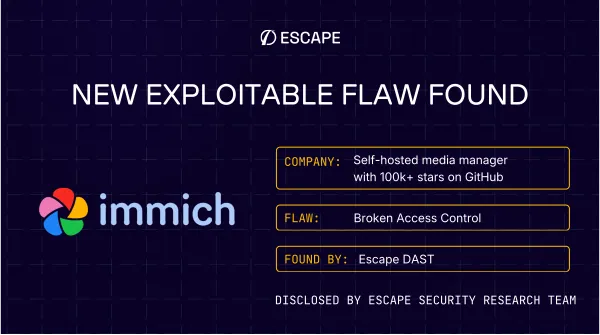
How the Escape DAST uncovered a missing default that lets any Immich user read locked-folder photos without the PIN.
AI pentesting
If you're evaluating AI for offensive security right now, you're weighing two questions at once. The first: why not skip the tooling and point a frontier model at your apps yourself? The second: among the AI pentesting tools you could actually buy, which one earns the budget? We built this benchmark to answer both. Cascade, Escape’s multi-agent AI pentesting engine, went up against a single frontier model (Claude Opus 4.8) driven directly at the same targets. The only variable is the harness ar
AI pentesting
TL;DR We pointed Cascade, Escape's AI pentesting solution, at a single Spring + JSP customer portal. It came back with two findings that are typically difficult for traditional Dynamic Application Security Testing (DAST) scanners to detect: * Unauthenticated RCE via SpEL injection. A ref request parameter was dropped, unsanitized, into a spring:eval expression inside a global JSP template. Because the JSP engine substitutes the value before SpEL parses it, an attacker controls the expression

Agentic Pentesting
At Escape, we routinely test the AI infrastructure that teams deploy inside their cloud environments. LLM gateways, RAG pipelines, model proxies: these are services that make outbound HTTP requests by design, which makes them natural targets for SSRF. When we looked at LiteLLM, we found three confirmed SSRF sinks, a security gate that was specifically built to prevent this exact bug class, and a bypass that means the gate itself is broken. The organization has confirmed to our research team th
Application Security
We benchmarked 4 AI pentesting tools: Escape, Shannon, Strix, and PentAGI against a modern vulnerable application. Learn more about their detection rates, false positive rates, and scanning speed.

Research
Hey there, With Halloween around the corner, what’s scarier for organizations than vulnerabilities in their web applications? And it's even scarier when the development of these applications is in the hands of users not familiar with security practices. This year, the Escape research team has focused on a growing area of concern: vibe-coded applications. Purpose-built platforms like Lovable.dev, Base44.com, and Create.xyz have democratized application development, enabling non-developers to d


Research
Hey there! Next week, social media will be flooded with Thanksgiving feasts (and Black Friday deals). But before you dive into the holiday shopping madness, the Escape team has prepared a special treat for you—not a Black Friday deal on Escape, of course, but rather some impressive findings on API security risks among Fortune 1000 and CAC 40 organizations. And trust us, the findings aren’t just “spicy” like your Thanksgiving stuffing—they’re quite scary... Using a combination of advanced subd



Research
tl;dr we scanned 6056+ public APIs on the internet with our in-house feedback driven exploration tech and ranked them using security, performance, reliability, and design criteria. We decided to analyze the resulting data and produce a full featured report: The State of Public APIs 2023 Why build this report? 🤔 Two weeks ago, we released apirank.dev, the result of extensive research on public APIs on the internet, conducted at an unprecedented scale using our feedback-driven API exploration

Announcement
tl;dr we scanned 6031+ public APIs on the internet with our in-house feedback driven exploration tech and ranked them using security, performance, reliability, and design criteria. The results are public on APIrank.dev. You can also request to index your own API for free and see how it compares to others. Why APIrank? 🤔 During a YC meetup, I spoke with fellow founder Andrew Kim from Finex. He told me about their struggle to select the right API providers in his past companies. It's true tha