AI pentesting: what it is, and what it can actually find

Introduction
AI pentesting is suddenly everywhere, and it works. At DARPA's 2025 AI Cyber Challenge, autonomous systems turned up 18 real bugs in open-source code at $152 per competition task, compared to bug bounties worth hundreds of thousands. The catch is that the phrase means two different things, and almost nobody specifies which.
This guide sorts that out, then shows you what decides whether an AI pentest finds anything, how to tell a real one from a scanner with a chatbot, and what to ask a vendor before you trust their tool.
⚡ tl;dr
- Two meanings: An agent that runs your pentest, or a test of your AI system.
- The harness, not the model: What an AI pentest finds comes from its map, its identities, and its scope.
- Proof beats a report: A proven exploit that re-runs on every build is coverage. A PDF is a snapshot.
AI pentesting actually means two different things
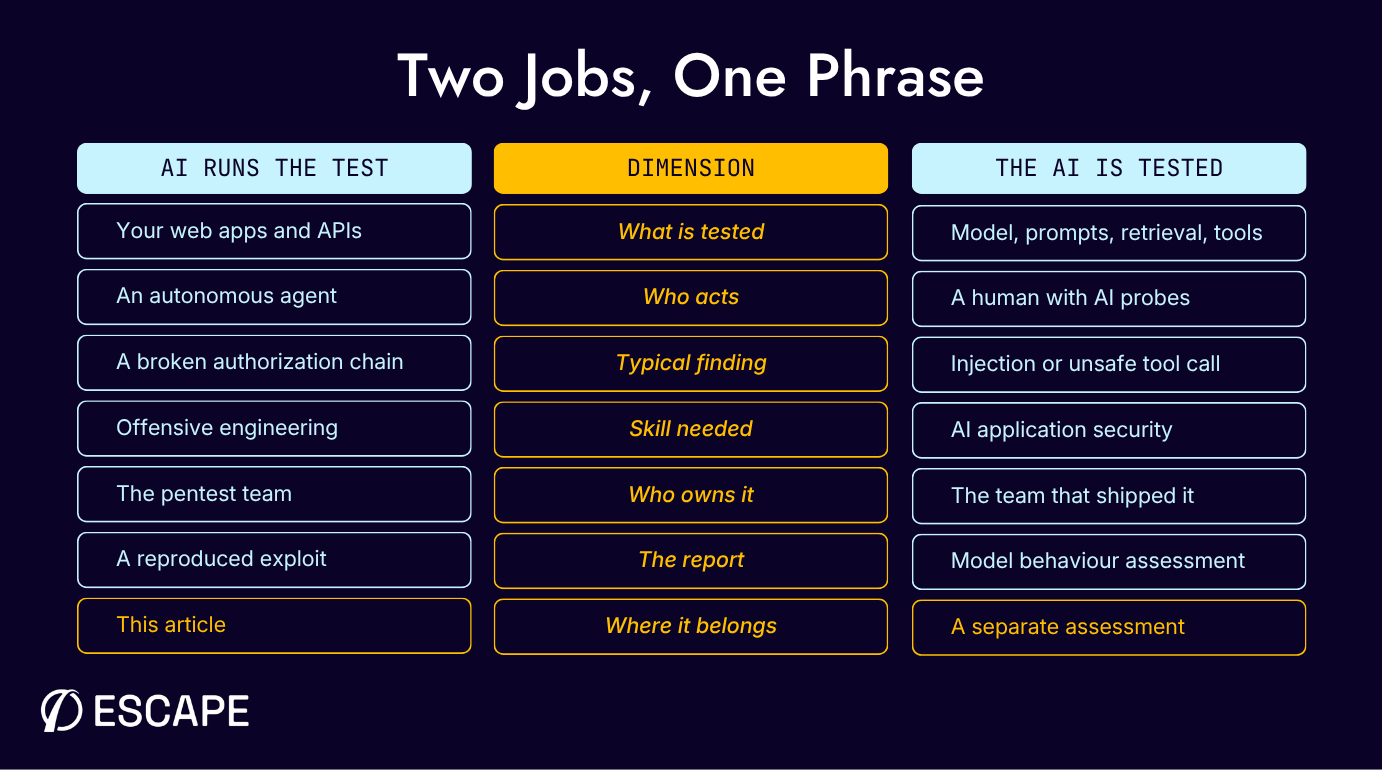
The confusing part is that the term covers two completely different jobs, and half the articles using it never say which. Sorting them apart takes a paragraph, and it saves you reading the wrong half of every other page on the subject.
What is AI pentesting?
AI pentesting, also written AI pen testing or AI penetration testing, is a penetration test that reproduces real attacker behavior, where an autonomous agent runs reconnaissance, chains the requests, and proves the finding. What you get back is a working exploit someone can reproduce, not a list of maybes.
A scanner throws a known payload at one endpoint and flags the potential vulnerabilities that match, so it can only find what's already in its pattern library.
An agent remembers what it saw from one step to the next, so it can chase a hunch that only pays off five requests later. That's why people call it autonomous penetration testing, or AI-driven pentesting, and not just faster scanning.
And what is AI security testing?
This is the other job, a test of the AI system itself. You're probing its model, prompts, and training data, its retrieval layer, and whatever tools it can reach, hunting flaws like prompt injection and weak prompt engineering.
It goes by AI security testing or AI red teaming, and it lands with the team that shipped the AI feature, not with your traditional pentesting program. Scoping for that job starts somewhere else entirely.
The Cloud Security Alliance points out that it depends on whether you call a provider's API, self-host a model, or fine-tune your own, and each answer changes what's yours to test. If that's the job you came for, the separate guide to pentesting LLMs and MCP servers covers it.
How an AI-driven pentest actually runs, stage by stage
An AI-driven run follows the same playbook as traditional penetration testing, so the method itself is nothing new. OWASP's Web Security Testing Guide names the recognized methodologies: its own framework plus PTES, NIST SP 800-115, OSSTMM, and the PCI guidance.
What changes is who does each stage, and how fast. Discovery maps the endpoints, open ports, inputs, parameters, and login flows, and that map caps everything that comes after.
Planning turns your threat model into what gets attacked and in what order. If you get that wrong then the budget burns rediscovering the app instead of the authorization chain that matters.
Execution chains requests together inside a scope that's actually enforced, not just asked for, and validation is the stage to grill in a demo. Reproducing a finding before filing it is what keeps you out of the flood of false positives that made security teams distrust automation.
Reporting hands over the request chain and the proof of impact. That gives you the quickest tell between a real AI pentest and a scanner with a chatbot, and the right-hand column is the exact line Escape's Cascade is built to sit on:
| Scanner with a chatbot | A real AI pentest | |
|---|---|---|
| Login | Stops at the login page | Authenticates and tests behind it |
| Identities | Tests as one user | Holds several at once |
| Findings | A list it never reproduced | Every one reproduced before it files |
Why AI security tooling is only as good as its harness
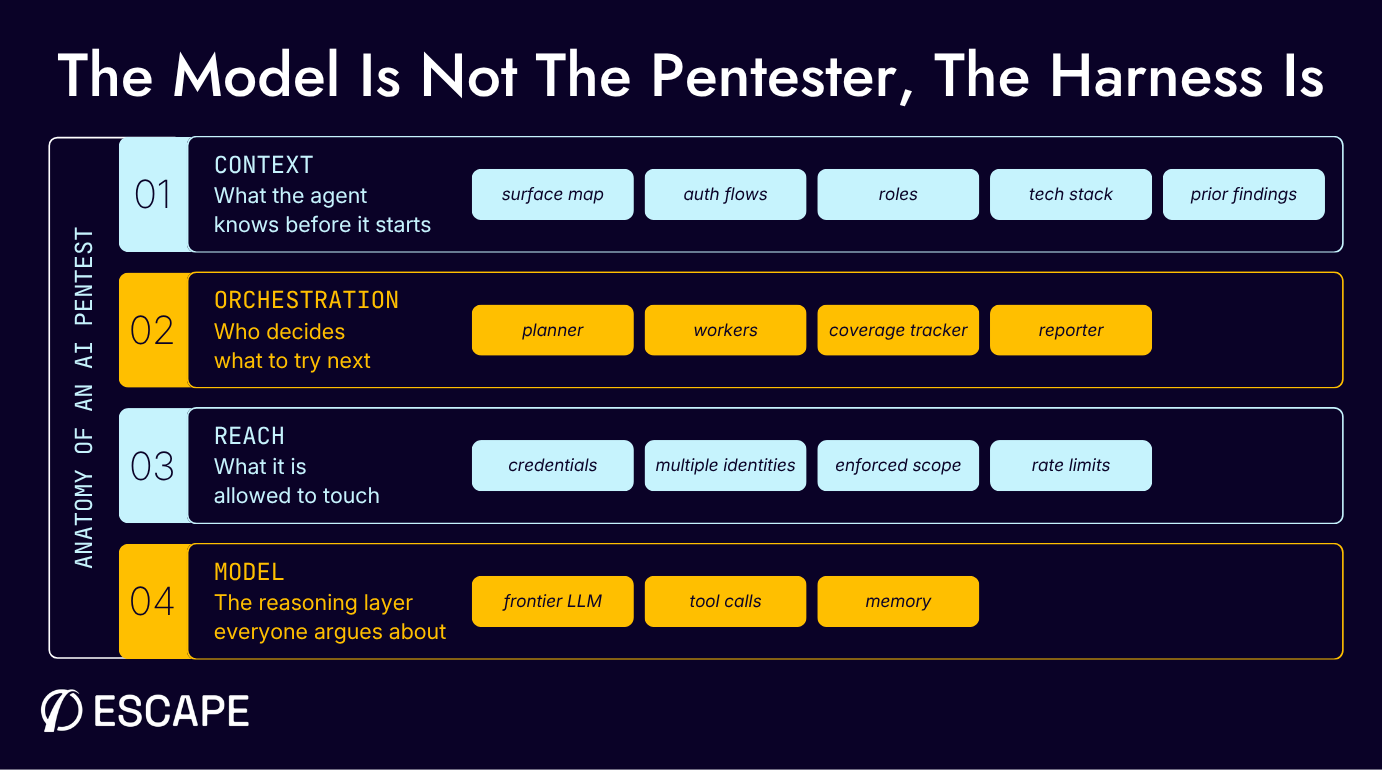
Across many organizations, the debate about AI pentesting comes down to the same question: which model is smartest? And it's the wrong one. What actually decides how much an agent finds is the machinery wrapped around the model, so change that machinery and the whole run changes.
What AI agents need before they find anything real
Four things decide how much an agent can find in modern environments, and none of them are the model:
- A current map of what's exposed, from continuous discovery.
- Working credentials, so it tests behind the login, not just in front of it.
- Multiple identities, so it can find broken access control.
- An enforced scope, so it stays on target and safe.
Skip the map, and it wastes its budget rediscovering your entire attack surface, from web apps and APIs to cloud infrastructure, instead of attacking it.
Google's Big Sleep agent found an exploitable stack buffer underflow in SQLite, which Project Zero calls "the first public example of an AI agent finding a previously unknown exploitable memory-safety issue in widely used real-world software".
What made it work was the starting kit, not the model: a recently fixed bug with its commit and diff, a code browser, and a debugger for test cases. Take that away and the same model would find nothing.
An agent with one identity has nothing to compare against, so it can't see broken object-level authorization, and adding a second account alone typically surfaces 30 to 50 percent more issues.
A frontier model with none of the four inputs finds fewer issues than a weaker model with all four, so it’s the harness that really matters. Escape's in-depth benchmark measured exactly that: holding the model constant and changing only the harness, it turned up four times as many real findings, at a zero percent false-positive rate. Escape's Cascade is built around those four inputs, not around a bigger model.
Can it reach the rest of your attack surface?
Most of what matters lives behind a login, and an agent that can't authenticate only ever tests your public front door. So the real question for any AI-powered pentester is whether it can hold a session through your login flow, MFA and CAPTCHA included.
Escape's authentication support is built for exactly this:
- OAuth in all three grant types.
- MFA, including time-based one-time passwords.
- CAPTCHA, allowlisted in test environments.
- Cognito, GraphQL, and digest for the rest.
- Browser Agent and Agentic Mode for flows that only complete in a real browser.
Under the hood, a custom procedure lifts a token from one response and injects it into the next with Jinja templating, so session management and token refresh don't silently break the run.
Reach also means how deep it can see, and how safely. Escape runs black-box from the outside for external exposures, grey-box with credentials, or white-box with read-only access to your source code.
Its scope is enforced in three places, a proxy that blocks out-of-scope requests before they reach the target, in-process checks, and the context the agents carry, with rate-limit and duration guardrails so a run stays inside the lines instead of hammering production.
Business logic was supposed to be untestable by machine
For years, business logic was the one thing everyone agreed a machine couldn't touch. OWASP's guide to business logic testing says this class of vulnerability "cannot be detected by a vulnerability scanner and relies upon the skills and creativity of the penetration tester", and that automating business logic abuse cases "is not possible and remains a manual art". Read closely, OWASP puts business logic beyond a scanner's pattern matching, but business logic is certainly not beyond an agent's reasoning.
The Google Threat Intelligence Group describes models as "effectively reading the developer's intent to correlate the 2FA enforcement logic with the contradictions of its hardcoded exceptions", surfacing "dormant logic errors that appear functionally correct to traditional scanners but are strategically broken from a security perspective".
Old automated penetration testing that pattern-matched at machine speed, and reading a developer's intent, are different. GTIG keeps its own qualifier in view and frontier models still struggle with complex enterprise authorization logic. Next to it sits a sharper fact: GTIG has, for the first time, identified a threat actor using a zero-day it believes was built with AI, planned for a mass exploitation event.
So the flaw class that held out against automation longest is the one a context-rich agent now has the best shot at, and the one that hurts most when it ships, and that’s the real risk in your estate.
Where AI pentesting still falls short, and what it leaves for humans
It's worth reading those same DARPA numbers from the top the other way, too. Roughly one in seven planted bugs went undiscovered, and about a fifth of what was found never got patched - and that was teams playing for a scoreboard. Your estate is messier, and nobody's keeping score.
The open problems here are well documented; Happe and Cito put reliability, safety, cost, privacy, and accountability at the top of the list, and a bigger model fixes none of them.
The problem you'll hit first is simpler: runs aren't deterministic, so the same agent against the same target hands back different findings on different days, and won't surface the same finding twice.
So a hit rate across several runs tells you more than any single pass. Agents become a force multiplier, taking over the repeatable coverage work, while scoping, authorization, inventing new attacks with tools like Burp Suite, human validation, and accountability stay with human testers on your security team.
The real question is where your team's hours go once the routine work is off their plate.
Turning one proven exploit into lasting coverage
A pentest is only as good as what it leaves behind, and most leave a PDF that is stale by the end of one sprint. What turns a one-off assessment into coverage you can count on is whether the proof it produced outlives your next deployment.
Real attack paths, not false positives
People fix a finding when they can watch it work, and Escape reports engineers remediate roughly three times faster once a finding ships with a working exploit. A report built on severity labels only starts a triage argument, but a reproducible exploit ends it.
Escape's documentation draws that line between a claim and a demonstration, where a proof of exploit carries the real attack path, the full request chain as reproduction steps you can replay with cURL, screenshots, the agent's own execution logs, and an Escape severity rating with a CVSS score, the exploitable risk spelled out.
Coverage matters just as much as the proof does. A run that records what it looked at, not just what it found, is the only kind you can trust when it comes back clean. Use published comparisons of AI pentesting tools to build a shortlist, not to make the call.
How a finding survives the next release
For many teams, point-in-time testing that ends in a document starts going stale the day it lands, because, unlike traditional software, your estate is constantly changing and the next deploy changes what was tested.
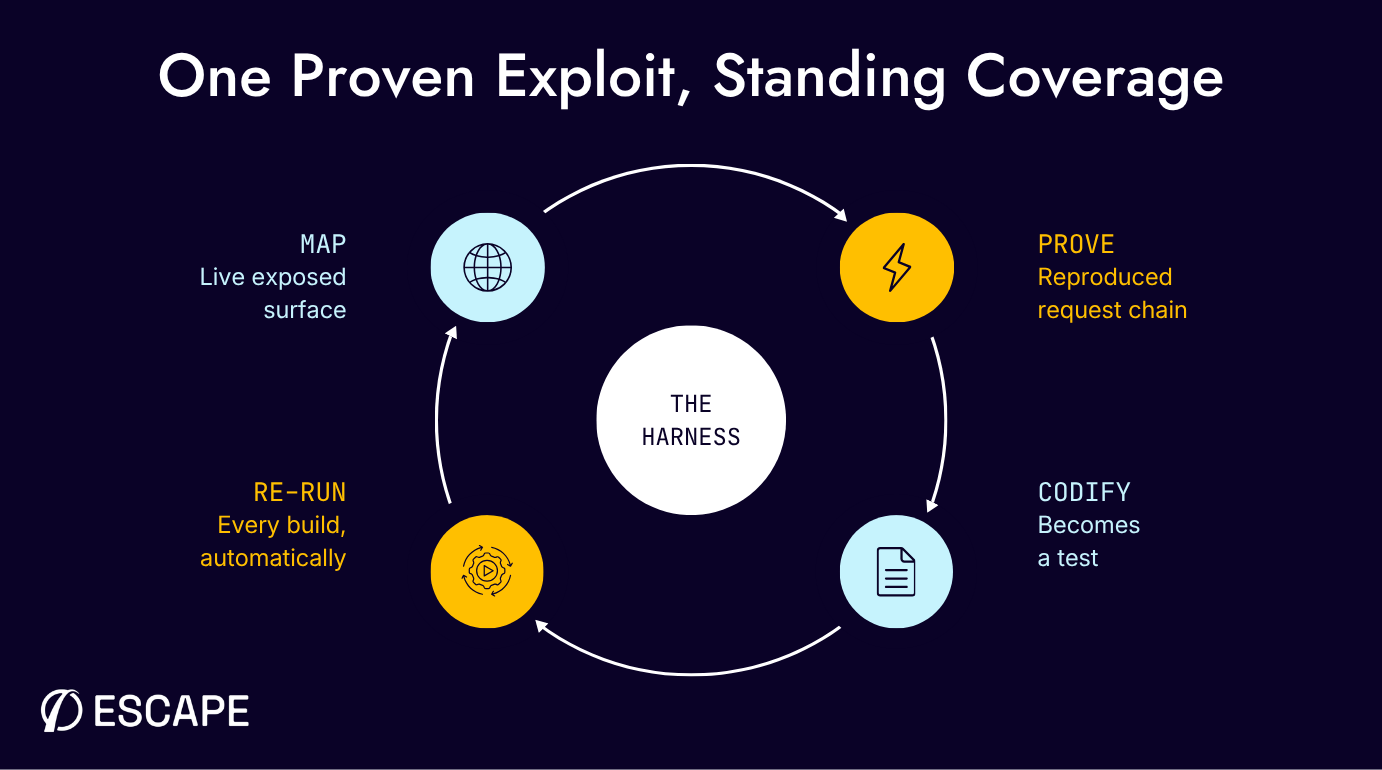
The fix is boring, but it works. Take the proven exploit, turn it into a test, and run it on every build. That's what continuous penetration testing and continuous validation rest on, an ongoing process, not a faster calendar.
Escape documents Cascade as an orchestrated swarm, that spawns short-lived workers for reconnaissance, exploitation, and access-control testing. Two more roles cover validation and coverage, a reporter that independently reproduces each candidate finding before it's filed, which is the real answer to the fear that a language model just hallucinates vulnerabilities, and a coverage agent that steers the orchestrator toward untested surfaces.
Here is the part that actually compounds over time. Escape feeds verified findings back in as automated regression tests that run on every build with DAST. Cascade proves the exploit once, DAST re-runs it on every release, and one engagement quietly becomes regression testing nobody has to schedule.
What compliance actually asks for
An assessor's first question isn't whether a human or an agent did the testing, which catches people off guard when they come ready to fight about it. Three things decide it, and none is who held the keyboard:
- A named, published methodology the run maps to, the kind compliance frameworks recognize, and the ones listed earlier all predate agents.
- Reproducible evidence for every finding, held to the gold standard of a human-led report, with a coverage record beside it.
- A named human who owns the scope and signs the report, because accountability doesn't move to a tool.
Whether a given assessor accepts agent-driven testing is their call, and pretending otherwise just costs you credibility in the room. Bring a mapped methodology, reproducible proof, a coverage record, and a signature, and you're on ground they recognize.
Conclusion
What decides your results isn't how clever the model is but what you hand the agent: a current map, more than one identity, an enforced scope, and proof that survives the next deploy. Escape puts all four in one place, Cascade builds the map, tests as several users at once, and proves each exploit, then DAST re-runs that proof on every build. Attackers already work this way, so the real question is whether your own testing keeps up, and you can see what that would look like on your surface by booking a demo with Escape.
FAQs
Can AI do pentesting?
Yes, within limits worth being honest about. AI agents can run reconnaissance, chain requests across several steps, and reproduce a working exploit, and government-run competition results show systems doing exactly that against real open-source code. Setting scope, getting authorization, and owning the report still sit with a human.
What is the difference between AI pentesting and pentesting an AI system?
They are two different jobs sharing a phrase. AI pentesting in the sense used here means an agent runs the penetration test against your web apps and APIs, while pentesting an AI system means assessing the model, its prompts, its retrieval layer, and the tools it can call.
How does AI penetration testing work?
An AI agent starts with a map of the exposed attack surface, plans what's worth attacking, tests the running web application, reproduces anything exploitable to validate the vulnerabilities it finds, and gives you full visibility into what it covered and what it found. Quality depends less on the model than on the context, credentials, identities, and enforced scope the surrounding system gives it, and that's what moves your overall security posture, for teams building systems faster than they can test them.
What can an AI pentest find that a scanner cannot?
The difference shows up in the multi-step, identity-dependent flaws real cyberattacks rely on. A scanner tests one endpoint at a time against known attack patterns, so it structurally can't ask whether one user reaches another user's sensitive data, whether a business process can be completed out of order, or whether a bug chains into remote code execution.
Will AI replace penetration testers?
Not on the current evidence, and not in the way the question implies. Published research on the offensive security use of large language models lists reliability, cost, accountability, and safety as open problems that a bigger model doesn't resolve, so the repeatable coverage work moves while scoping, human expertise, and accountability stay with human pentesters.
Is AI pentesting accurate enough to trust?
Judge it on the evidence, not the verdict. A finding worth acting on turns up with the attack path, the full request chain, and a screenshot of the exploit landing, so you can reproduce it without taking anyone's word. Ask any tool what it looked at, not just what it found.
What should you look for when evaluating one?
When you compare AI security tooling, four questions are worth asking, and they're all mechanical. Does it start from a current map of your attack surface, can it hold more than one identity at once, does every finding ship with a reproducible proof, and does that proof become a test that re-runs on later builds? An independent benchmark comparing detection and false-positive rates tells you more than any feature list.
Can AI-powered pentesting get past MFA and CAPTCHA?
Yes, and it's the line between testing your login page and testing everything behind it. Escape authenticates through OAuth, MFA with one-time passwords, and CAPTCHA by allowlisting test environments, and its Browser Agent and Agentic Mode work out flows that only complete in a real browser. An agent that can't do this reports your authenticated surface as clean because it never reached it.
Won't an AI pentester just hallucinate vulnerabilities?
That's the right worry about any language model, and it's why the validation step matters more than the model. A finding only counts once the tool validates the vulnerability by reproducing it with a working request chain, so a hallucinated bug never makes it into your report. Ask any tool whether every finding ships with a reproducible proof, not just a description.
Sources
- Web Security Testing Guide, Introduction to Business Logic - OWASP Foundation
- Web Security Testing Guide, Penetration Testing Methodologies - OWASP Foundation
- GTIG AI Threat Tracker - Google Threat Intelligence Group, May 2026
- AI Cyber Challenge marks pivotal inflection point for cyber defense - DARPA, August 2025
- From Naptime to Big Sleep - Google Project Zero, November 2024
- On the Surprising Efficacy of LLMs for Penetration-Testing - Happe and Cito, July 2025
- Considerations When Including AI Implementations in Penetration Testing - Cloud Security Alliance, April 2024